

Should You Invest in 10 Mutual Funds? 5 Smart Truths Every Delhi NCR Investor Should Know

Should you invest in 10 mutual funds portfolio diversification
More mutual funds do not always mean better diversification.

Should you invest in 10 mutual funds to achieve proper diversification?
This is a common question among Delhi NCR investors who started with one or two SIPs and gradually added more funds.

One mid-cap fund here, one flexi-cap fund there, and another scheme recommended by a friend can eventually turn into a portfolio of ten or more mutual funds.

But owning ten mutual funds and being genuinely diversified are not necessarily the same thing.

The important question is not simply how many funds you own. It is whether each fund has a clear purpose and contributes meaningfully to your overall financial goals.

1. Why the Number of Funds Isn’t the Real Question

Diversification depends on what your investments actually hold, rather than the number of schemes in your portfolio.

For example, three large-cap mutual funds may invest in many of the same companies. Although the fund names and fund managers are different, their underlying holdings may overlap significantly.

This means a portfolio can appear diversified while still having considerable exposure to the same stocks or sectors.

Before adding another mutual fund, consider:

  • Underlying stock holdings
  • Overall asset allocation
  • Investment time horizon
  • Risk tolerance
  • The purpose of each fund
  • Your financial goals

Instead of focusing only on the number of schemes, understand how each investment fits into your complete portfolio.

2. How Mutual Fund Portfolios Quietly Become Overcrowded

Most investors do not intentionally decide to create a portfolio of ten mutual funds.

It often happens gradually. A fund generates strong recent returns, a new category becomes popular, or someone recommends another SIP. Over time, more schemes are added without reviewing the existing investments.

This can create two common challenges.

Fund Overlap

Different mutual funds may hold similar companies or sectors. This can reduce the diversification benefit you expected from owning multiple schemes.

Portfolio Complexity

When you own too many funds, it may become difficult to understand:

  • Where your money is invested
  • Which funds serve similar purposes
  • Whether your asset allocation remains suitable
  • Which investments need periodic review

A larger portfolio is not automatically a better portfolio. Clarity and suitability matter.

3. Should You Invest in 10 Mutual Funds?

There is no universal number of mutual funds that every investor should own.

The appropriate number depends on factors such as your investment amount, financial goals, risk profile, time horizon, and the role of each scheme.

An investor with multiple financial goals and a diversified asset allocation may have different requirements from someone who is starting their first SIP.

For many investors with relatively straightforward goals, adding funds only to increase the number of schemes may not provide meaningful benefits.

Before investing in another mutual fund, ask yourself:

What does this fund add to my existing portfolio that I do not already have?

If you cannot clearly explain its purpose, take time to review your existing investments before adding another scheme.

4. A Simple Test Before Adding Another Fund

Before deciding whether you should invest in 10 mutual funds or maintain a smaller portfolio, ask yourself these three questions.

1. Does the Fund Have a Different Purpose?

Does the new fund serve a different investment objective from your existing schemes?

Avoid adding a fund merely because it belongs to a different category or has recently delivered strong returns.

2. Does It Improve Diversification?

Review the fund’s underlying holdings and sector exposure. Different fund names do not necessarily mean different investments.

3. Would You Choose It Today?

Imagine that you were building your portfolio from scratch.

Would you still select this fund based on your current goals, risk profile, and investment strategy?

This question can help identify investments that remain in a portfolio simply because they were purchased in the past.

5. What If You Already Own 10 or More Funds?

If you already own ten or more mutual funds, do not rush to sell them only because the number appears high.

Instead, begin with a structured portfolio review.

Step 1: List All Your Funds

Prepare a list of your mutual funds, investment amounts, SIP contributions, and financial goals.

Step 2: Understand Each Fund’s Role

Identify whether each scheme is intended for long-term growth, a specific goal, diversification, or another purpose.

Step 3: Review Portfolio Overlap

Check whether multiple funds have similar holdings, sector exposure, or investment objectives.

Step 4: Review Your Asset Allocation

Understand your overall exposure to equity, debt, and other asset classes according to your financial needs and risk profile.

Step 5: Consider Consolidation Carefully

After reviewing the portfolio, you may identify opportunities to simplify your investments. Any decision to switch or redeem should consider factors such as taxes, exit loads, investment goals, and suitability.

The objective should not be reaching an arbitrary number of funds. The objective should be creating a portfolio that is understandable and aligned with your financial goals.

6. GCIC Finserve’s Approach for Delhi NCR Investors

At GCIC Finserve, we believe the right question is not simply, “Should you invest in 10 mutual funds?”

The more important question is:

Does every mutual fund in your portfolio have a clear reason to be there?

As an AMFI-registered Mutual Fund Distributor (ARN-272705), GCIC Finserve helps investors understand their portfolio structure, identify potential overlap, and review investment choices in the context of their financial goals.

Investors in South Delhi, Gurgaon, Noida, Ghaziabad, and other parts of Delhi NCR can consider reviewing their existing portfolio before adding another scheme.

You can explore our Financial Assessment page or visit our Contact Us page to learn more about the available services.

For investor education and mutual fund-related resources, visit AMFI India.

7. Frequently Asked Questions

Q1. Should you invest in 10 mutual funds?

It depends on your financial goals, risk profile, asset allocation, and the purpose of each fund. The number of schemes alone does not determine diversification.

Q2. How many mutual funds should I own?

There is no fixed number that applies to every investor. Choose investments based on your goals and whether each fund serves a distinct purpose.

Q3. Can different mutual funds hold the same stocks?

Yes. Different mutual funds can hold many of the same companies. This is known as portfolio overlap.

Q4. Should I sell my mutual funds if I own 10 or more?

Not automatically. Review each fund’s role, holdings, costs, tax implications, and suitability before making any decision.

Q5. How can I identify mutual fund overlap?

You can compare the underlying holdings, sector exposure, and investment objectives of your mutual funds. A portfolio review can help you understand similarities between schemes.

Final Word

The real question is not How many mutual funds should I own?

It is:

Does every fund in my portfolio have a clear reason to be there?

A portfolio with fewer funds may be easier to monitor, while a larger portfolio may be appropriate for certain investors and goals. What matters is whether your investments are suitable, understandable, and aligned with your financial plan.

Before adding your next mutual fund, review what you already own.

Disclaimer

This article is intended solely for educational and informational purposes and should not be construed as investment advice. Mutual fund investments are subject to market risks. Please read all scheme-related documents carefully before investing. Consider your financial goals, risk profile, and investment horizon before making investment decisions.
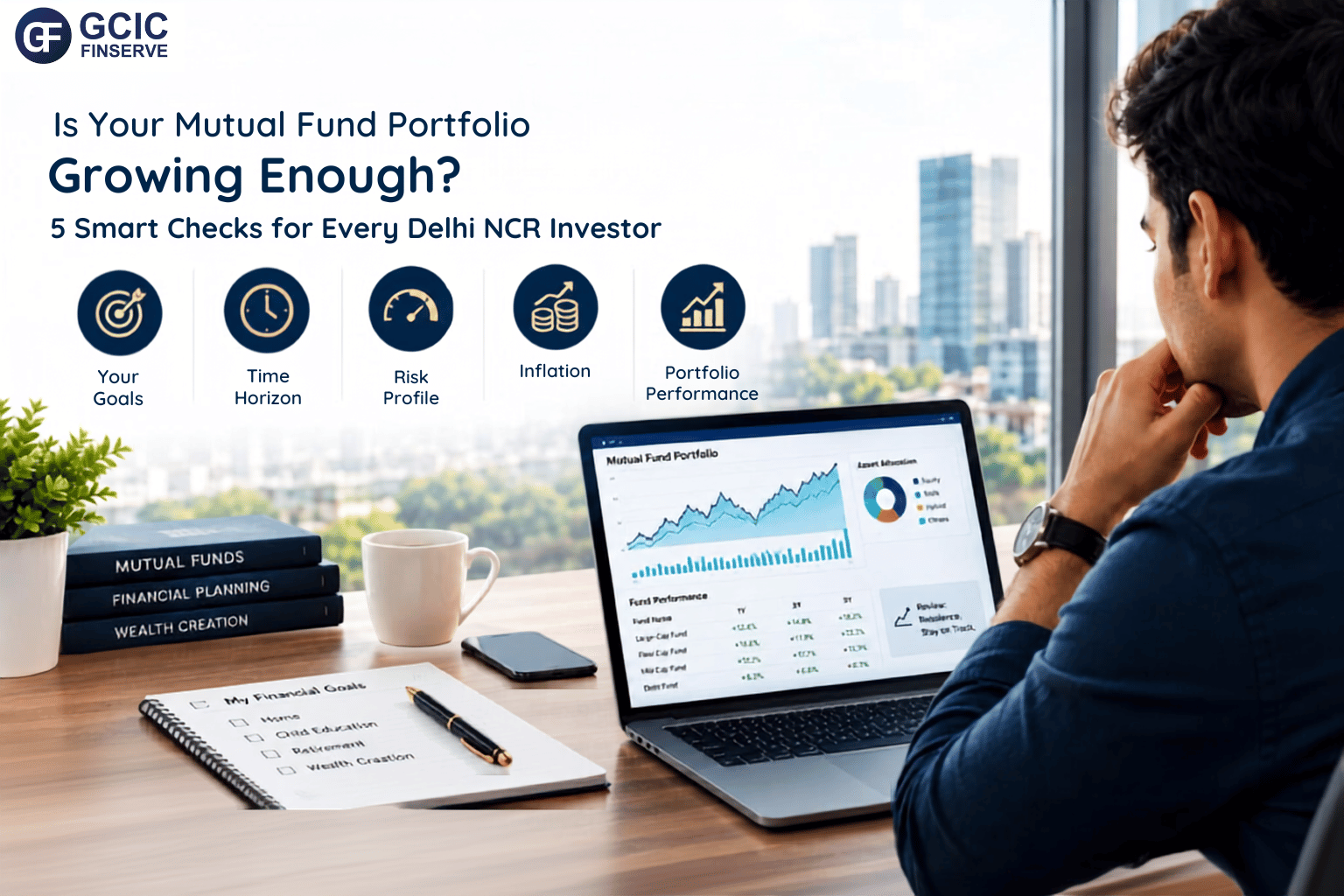
Is Your Mutual Fund Portfolio Growing Enough? 5 Smart Checks Every Delhi NCR Investor Should Run

mutual fund portfolio growing enough for long term financial goals
Is your mutual fund portfolio growing enough to support your financial goals?

Is your mutual fund portfolio growing enough—or just growing? Most investors in Delhi NCR know exactly how much their portfolio is worth today, but far fewer stop to ask if it’s growing at the rate they actually need. Watching your money move from ₹20 lakh to ₹25 lakh feels encouraging, but if that growth is genuinely “enough,” it depends entirely on what the money is meant to fund, when you’ll need it, and how much your goal will actually cost by then.

What Does “Growing Enough” Really Mean?

There’s no universal number that makes a return “good” for every investor. Someone investing for retirement 20 years away and someone saving for a house in Gurugram in 3 years could both have ₹25 lakh invested—yet their portfolios need to behave completely differently. If a mutual fund portfolio is growing enough depends on your financial goal, time horizon, inflation, current corpus, ongoing contributions, and risk profile. A portfolio should never be judged in isolation—only against the job it’s actually meant to do.

Why Inflation Matters for Your Mutual Fund Portfolio

Inflation is one of the biggest reasons Delhi NCR investors underestimate how much they truly need. If you want ₹1 crore for a goal 15 years away and inflation averages around 6%, the purchasing power of that ₹1 crore today could require closer to ₹2.4 crore by the time you reach your goal. So the real question isn’t “Can I build ₹1 crore?”—it’s “How much will my goal actually cost when I get there?” Your strategy should be based on this future value, not today’s price tag.

Don’t Judge a Single Year’s Return

Mutual fund returns swing considerably year to year, especially in equity. A portfolio might deliver 15% one year, dip 8% the next, and recover strongly after that. Looking only at the last 12 months can give a misleading picture of whether your mutual fund portfolio is growing enough. For long-term investors, metrics like CAGR, rolling returns, and XIRR—particularly useful for SIP investors since money enters at different points in time—offer a far more honest read of your actual trajectory.

Your Mutual Fund Portfolio Doesn’t Have to Beat the Nifty

A common mistake is comparing every portfolio against the Nifty 50. If the index delivers 14% and your portfolio delivers 11%, that doesn’t automatically mean it has underperformed. The Nifty 50 represents a specific set of large-cap companies, while your portfolio may hold a mix of large-cap, mid-cap, and debt funds designed to balance growth with stability. The more meaningful comparison runs from your portfolio to an appropriate benchmark to category performance and finally to the return your specific goal actually requires.

The Return You Need Is More Important Than the Return You Want

There’s a real difference between “what’s the highest return I can chase?” and “what return does my plan actually need?” If your goal requires an average of 10% over 15 years, chasing funds that recently delivered 18–20% may mean taking on far more risk than necessary. On the flip side, if your portfolio is tracking closer to 6% while your plan needs 10%, staying invested without a review could leave your mutual fund portfolio short of the target. The objective isn’t maximum return at any cost—it’s a reasonable return for the risk your goal actually requires.

5 Smart Checks: Is Your Mutual Fund Portfolio Growing Enough?

  1. What is this portfolio meant to achieve? Every investment should have a defined purpose.
  2. How much will I actually need? Factor in inflation and any changes to your goal’s future cost.
  3. How much time do I have? A 15-year horizon is evaluated very differently from a 3-year one.
  4. What return does my plan require? Work backwards from your goal instead of chasing an arbitrary number.
  5. Am I on track? Compare your current corpus and contribution rate against what you’re likely to need.

If your answer to that final question is no, identify why before switching funds impulsively—it could simply mean investing a little more each month rather than chasing a “better” fund.

When Should You Actually Be Concerned?

A slow-growing portfolio isn’t automatically a problem, but a proper review becomes important if you notice consistent underperformance against an appropriate benchmark, an asset allocation that no longer matches your goals, excessive concentration in one fund or sector, a major change in your financial circumstances, or a goal approaching without sufficient capital built up. According to AMFI’s investor education resources, reviewing your fund’s category and benchmark performance periodically—rather than reacting to short-term swings—is a healthier way to judge whether your mutual fund portfolio is growing enough.

GCIC Finserve’s Perspective for Delhi NCR Investors

At GCIC Finserve, we help Delhi NCR clients look beyond the headline return and ask the more important question: is your mutual fund portfolio genuinely growing enough for the life you’re planning? As an AMFI-registered Mutual Fund Distributor (ARN-272705), our team helps map your current investments against your real goals, time horizon, and risk profile. Book a portfolio review with our team before deciding whether your investments need a change.

FAQs

Q1. What is considered a good return for a mutual fund portfolio? There’s no universal number—it depends on your goal, time horizon, inflation, contributions, and risk profile.

Q2. Should my mutual fund portfolio always beat the Nifty 50? No. A diversified portfolio may have a different asset mix, so it should be compared against an appropriate benchmark, not just the index in the news.

Q3. How do I know if my mutual fund portfolio is growing enough? Compare your current corpus and monthly contributions against what your goal will realistically cost, factoring in inflation and your remaining time horizon.

Q4. How often should I review my mutual fund portfolio? A periodic review—rather than daily monitoring—helps confirm your investments, allocation, and goals remain aligned.

Final Word

The next time you check your investments, don’t just ask, “How much did I make?” Ask instead, “Is my mutual fund portfolio growing enough for where I actually want to go?” That’s the number that matters far more than last year’s headline return.


Disclaimer: This article is intended solely for educational and informational purposes and should not be construed as investment advice. Mutual fund investments are subject to market risks. Please review scheme-related documents and consult a registered advisor before investing.

Ronald Read Investor Story: The Janitor Who Built an $8 Million Fortune

Ronald Read investor story about a janitor who built an $8 million fortune through disciplined investing
The Ronald Read investor story highlights the power of disciplined investing, patience and long-term wealth creation.

The Ronald Read investor story is a powerful reminder that building substantial wealth isn’t always about earning a high income. Discipline, consistent saving, sensible investing, and time can also play an important role in long-term wealth creation.

Ronald Read worked as a gas station attendant and later worked as a part-time janitor at J.C. Penney in Brattleboro, Vermont. When he passed away in 2014 at age 92, his estate was reportedly worth around $8 million.

What made his story remarkable was not simply the amount of wealth he accumulated, but the quiet and disciplined way in which he built it.

Who Was Ronald Read?

Read came from modest beginnings, served in World War II, and lived a relatively simple life.

Over several decades, he saved and invested while maintaining a lifestyle far removed from the image many people associate with significant wealth.

After his death, a significant portion of his estate was donated to charitable causes, including Brattleboro Memorial Hospital and Brooks Memorial Library.

His story became a powerful example of how financial behavior can matter just as much as income.

The Real Lesson Behind the Ronald Read Investor Story

What makes this story relevant today is how the wealth was accumulated.

Read was reported to have invested in shares of established companies and held investments for long periods rather than constantly buying and selling based on short-term market movements.

His story illustrates an important principle:

Building wealth is not always about finding the next big opportunity. Sometimes it is about consistently making sensible decisions and giving them enough time to work.

A high salary can make investing easier, but income alone does not create financial security.

Saving, investing, controlling expenses, and maintaining a long-term perspective can all play an important role.

Key Takeaways for Indian Investors

1. Start early, even if you start small

Waiting until your income becomes significantly higher may mean missing valuable time for long-term investing and compounding.

Starting with an amount that fits your financial situation can help establish a consistent investing habit.

2. Think long term

Markets can experience periods of volatility, but long-term investing is fundamentally different from trying to predict every short-term movement.

3. Keep expenses under control

Living below your means can create more room for saving and investing.

4. Let time work

Compounding becomes increasingly powerful when investments remain invested for long periods.

For long-term investors, staying invested consistently may be more practical than trying to predict every short-term market movement.

How This Applies to Investors in Delhi NCR

For many families across Delhi NCR, wealth creation can sometimes feel like something reserved for people with very high incomes.

The Ronald Read story offers a different perspective.

A disciplined investment approach, when aligned with long-term financial goals, can help investors work toward building wealth over many years.

A Systematic Investment Plan (SIP) is a method of investing a fixed amount at regular intervals in a mutual fund scheme. The amount and investment approach should depend on an individual’s financial goals, time horizon, and risk tolerance.

The key lesson isn’t that every investor will achieve Ronald Read’s outcome.

It is that starting early, staying consistent, and giving investments sufficient time can make a meaningful difference.

Common Mistakes That Can Disrupt Long-Term Wealth Creation

  • Waiting for a higher salary before starting
  • Frequently changing investments because of market noise
  • Making decisions based purely on short-term market movements
  • Investing without clearly defined financial goals
  • Ignoring risk while focusing only on potential returns

Building Your Own Long-Term Wealth Plan

If you want to apply the principles from the Ronald Read story, start with a simple framework:

  1. Define your financial goals.
  2. Determine how much you can invest regularly.
  3. Choose investment options appropriate for your goals and risk tolerance.
  4. Stay focused on your long-term time horizon.
  5. Review your investments periodically rather than reacting to every market movement.

At GCIC Finserve, we help investors explore investment solutions based on their financial goals, investment horizon, and individual requirements.


The objective isn’t to chase every market opportunity. It is to build a disciplined approach that can remain aligned with your long-term financial journey.

Final Thoughts

The Ronald Read investor story isn’t simply about a million-dollar fortune. It is a story about discipline, patience, controlled spending, and the power of time.

You don’t need to look wealthy to be building wealth.

Sometimes the most important financial decisions are the ones nobody sees.

Want to explore investment solutions for your long-term goals?

Connect with GCIC Finserve.

FAQs

1. Who was Ronald Read?
Ronald Read was a US janitor and gas station attendant whose disciplined saving and long-term investing helped him build an estate reportedly worth around $8 million.

2. What can investors learn from the Ronald Read investor story?
The key lessons are starting early, investing consistently, controlling expenses, and staying focused on long-term goals.

3. Can Indian investors apply the lessons from Ronald Read’s story?
Yes. Indian investors can apply these principles through disciplined saving, suitable investment options, and a long-term approach aligned with their goals and risk tolerance.

4. How can GCIC Finserve help with long-term investment goals?
GCIC Finserve provides investment solutions based on financial goals, investment horizon, and individual requirements, helping investors explore suitable options for their long-term journey.


Disclaimer: Investments are subject to market risks. Past performance or historical examples do not guarantee future results. Please read all scheme-related documents carefully and consider your financial goals, investment horizon, and risk tolerance before investing.