
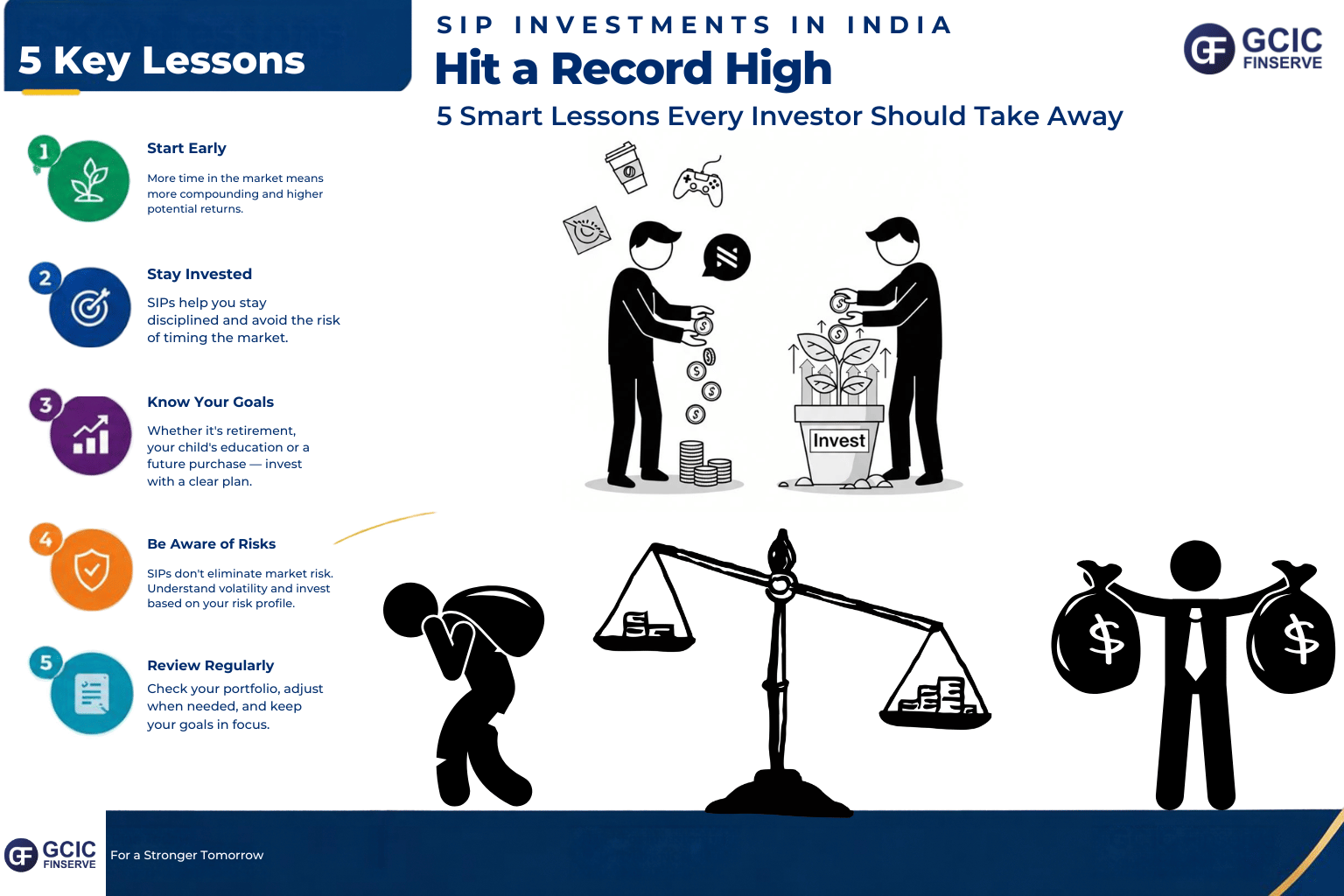
SIP Investments in India Hit a Record High: 5 Smart Lessons Every Delhi NCR Investor Should Take Away

SIP investments in India hit a record high with ₹32,297 crore monthly contribution in August 2026
India’s monthly SIP contribution reached a record ₹32,297 crore in August 2026, according to AMFI data.

SIP investments in India hit a record high of ₹32,297 crore in August 2026—the highest monthly SIP contribution ever recorded by AMFI. Ten years earlier, in August 2016, that number was just ₹3,497 crore. That’s a more than nine-fold jump in a decade. But behind this headline number is a much more interesting story for Delhi NCR investors: how Indians are quietly changing the way they think about money and what the cost of waiting to invest actually looks like.

Just How Big Is India’s SIP Boom?

The scale becomes clear when you place the numbers side by side. Monthly SIP contributions rose from ₹3,497 crore in August 2016 to ₹32,297 crore in August 2026. Outstanding SIP accounts reached 10.75 crore, with 10.02 crore actually contributing that month, and SIP assets under management touched ₹18.62 lakh crore. AMFI also recorded 66.40 lakh new SIP registrations in August alone, against 53.82 lakh SIPs that were discontinued or completed—a net addition of roughly 12.58 lakh accounts in just one month. SIP investments in India hitting a record high comes as part of a much larger increase in SIP participation over the past decade. 

The Bigger Mutual Fund Story Behind the Numbers

SIPs are just one part of a much larger transformation. India’s overall mutual fund industry AUM stood at ₹87.08 lakh crore at the end of August 2026, up roughly six-fold from ₹15.63 lakh crore in August 2016. Mutual fund folios have grown from 10.86 crore in August 2021 to 28.35 crore in August 2026—more than a two-and-a-half-fold increase in just five years, with roughly 21.62 crore of those folios in equity, hybrid, and solution-oriented schemes. For Delhi NCR households, this points to something bigger than a passing trend: organized, systematic investing is becoming the norm rather than the exception.

Why Has the SIP Become So Popular?

The appeal is part mathematics, part psychology. Ask someone to invest ₹12 lakh in one go, and it immediately raises hard questions—where will the money come from, is the market at the right level, and what if it falls right after? Ask instead, “Can you invest ₹10,000 a month?” and the decision suddenly feels manageable. According to AMFI, a SIP, is simply a method of investing a fixed amount periodically in a mutual fund scheme, helping investors stay disciplined without trying to time the market. It’s worth remembering: a SIP is a method of investing, not an investment product in itself—the underlying mutual fund is what actually carries the risk and return.

The Real FOMO Isn’t About Missing the Next Rally

The common fear is “the market went up; I should have invested earlier.” But that’s not the FOMO that matters most. Consider two people who both could have started investing ₹10,000 a month five years ago—one did, one kept waiting for the “right time.” Five years later, the person who started has something the other person can never buy back: five years of investment time. You can increase your SIP amount later, change your strategy later, or even recover from a bad investment choice later—but you cannot recover lost time.

What Does Starting Early Actually Do?

Here’s a simple illustration. Investing ₹10,000 every month for 20 years means a total contribution of ₹24 lakh, which at an illustrative 12% annualized return could grow to approximately ₹99 lakh. Wait five years, and investing the same ₹10,000 monthly for only 15 years brings the total contribution down to ₹18 lakh, with an illustrative corpus of around ₹50 lakh. (These are hypothetical illustrations, not guaranteed returns—actual outcomes depend on market performance, fund selection, costs, and taxes.) The investor who waited contributed just ₹6 lakh less, yet the eventual illustrative gap is far larger—because those extra five years of compounding matter more than the headline contribution amount.

The Other Side of the SIP Story

Record SIP contributions shouldn’t push anyone into investing blindly. When your colleague has an SIP, your friend has three mutual funds, and headlines talk about ₹32,297 crore flowing in every month, it’s easy to feel like you’re “behind”—but that’s FOMO, not a strategy. The fact that millions of Delhi NCR residents (and Indians nationwide) are investing through SIPs doesn’t tell you what to invest in, how much risk to take, or which mutual fund category actually suits your goal. It’s also worth remembering that an SIP doesn’t remove market risk—if you’re invested in equity mutual funds, your value can still fall when markets fall. A SIP simply means you keep investing on schedule; it doesn’t eliminate volatility.

3 Questions to Ask Before Starting a SIP

Before jumping in because “SIP investments in India hit a record high” made headlines, ask yourself:

  1. What am I actually investing for? Retirement, a child’s education, or a future purchase can each call for a different approach.
  2. How long can I realistically stay invested? Your time horizon should match the volatility you’re willing to sit through.
  3. How much can I invest without disrupting my monthly budget? A sustainable SIP beats an aggressive one you can’t maintain past a few months.

GCIC Finserve’s Perspective for Delhi NCR Investors

At GCIC Finserve, AMFI-registered Mutual Fund Distributor (ARN-272705), we see the SIP boom as a genuine shift in household financial behavior—but record flows should never replace a plan built around your own goals and risk profile. If you have a long-term goal and keep postponing simply because the timing never feels perfect, it’s worth understanding what that delay is actually costing you in lost compounding time. Connect with our team to understand which mutual fund categories might suit your goals. For the latest official SIP and mutual fund industry data, refer to AMFI India’s official reports.

FAQs

Q1. Are SIP investments in India really at a record high?

Yes—AMFI reported ₹32,297 crore in monthly SIP contributions in August 2026, the highest in its published series.

Q2. Does a record SIP contribution mean the stock market will rise? No. SIP flows reflect investor participation, not a reliable signal of future market direction.

Q3. Is it too late to start a SIP now that contributions are at record highs? 

There’s no universal answer—it depends on your goals, horizon, and risk tolerance. But waiting indefinitely for a “perfect” entry point can mean losing valuable compounding time.

Q4. Does starting a SIP early guarantee higher returns? 

No. Starting earlier gives your investment more time to potentially compound, but actual returns still depend on market performance and the underlying fund.

Final Word

SIP investments in India hitting a record high isn’t a signal to rush in—it’s a signal that Indian investors, including many across Delhi NCR, are increasingly treating investing as a recurring habit rather than a one-time event. You don’t need to feel FOMO because someone else started before you. But if investing genuinely fits your goals, understand what indefinite postponement is costing you. The market will offer many entry points over your lifetime—time is the one entry point you can’t revisit.

Disclaimer: Mutual fund investments are subject to market risks. Read all scheme-related documents carefully before investing. This article is for educational and informational purposes only and should not be construed as investment advice or a guarantee of returns. The illustrations used are hypothetical. Please assess your own financial circumstances and, where appropriate, consult a qualified financial professional before investing. Data source: Association of Mutual Funds in India (AMFI), August 2026.

Selling During a Market Crash: 5 Costly Lessons Every Investor Should Know

Selling during a market crash: investor journey from ₹60 lakh to ₹40 lakh and missed recovery
A visual story showing how panic selling during a market crash can lead to missed recovery and future compounding opportunities.

Selling during a market crash can feel like the safest decision in the moment. But when markets recover, investors who sold in panic can sometimes find themselves facing a different problem: how and when to get back in.

This is the story of Arjun, a fictional investor based on a situation many Delhi NCR investors can relate to. One five-minute decision during a period of market panic changed the way he approached his long-term investment journey.

The Setup: A Normal Long-Term Investment

In 2010, Arjun invested ₹25 lakh into a diversified equity portfolio with a simple goal: build wealth over the next 15–20 years and support his family’s future needs.

He wasn’t trading or looking for quick profits. For years, his plan worked reasonably well. His portfolio went through good years, bad years, and a few uncomfortable corrections.

Arjun understood that markets don’t move in a straight line, so he stayed invested. Then came a market fall that tested that confidence.

For investors who want to understand how different investment structures work, our guide on Mutual Funds vs PMS and AIFs explains the key differences between these options.

When ₹60 Lakh Started Looking Like ₹40 Lakh

At its peak, Arjun’s portfolio had grown to roughly ₹60 lakh.

Then the market entered a sharp decline. The value moved from ₹55 lakh to ₹48 lakh, then ₹42 lakh, and eventually ₹40 lakh.

Almost ₹20 lakh had disappeared from the portfolio value.

Arjun knew, in theory, that equity markets could fall. But watching his own money decline day after day felt very different from reading about market volatility in an article—the numbers started becoming emotional.

Market volatility is a normal part of investing, but the way an investor responds to it can have a major impact on their investment journey. SEBI’s investor-education material explains volatility risk and discusses diversification as one way investors can manage different investment risks. (SEBI Investor)

The Moment of Selling During a Market Crash

One evening, Arjun called his advisor and said,

“I don’t want to lose any more.”

He wasn’t asking what fund to buy next—he had already made up his mind.

Despite being reminded about his long-term goal, Arjun sold his remaining equity investments and moved ₹40 lakh into cash.

For the first time in weeks, he felt relieved.

At least, he thought, the portfolio couldn’t fall any further.

Selling during a market crash felt like the safest decision at that moment.

But the difficult part came later.

What Happened After He Sold

The market eventually stopped falling—and started recovering.

Arjun told himself he would invest again “when things became clearer.”

But clarity didn’t arrive on his preferred schedule.

The market recovered 10%, then another 10%. Arjun continued waiting for a clear signal that it was safe to return.

By the time the market looked comfortable again, prices had already moved significantly higher, and buying back in suddenly felt expensive.

So he waited for another correction—one that didn’t arrive when he expected it.

Months became years, and the investor who had successfully avoided the fall ended up missing a significant part of the recovery.

NISM investor-education material similarly highlights the role of disciplined investing, long-term planning, and avoiding emotion-driven decisions during market fluctuations. (NISM)

The Two Paths: Staying Invested vs Staying in Cash

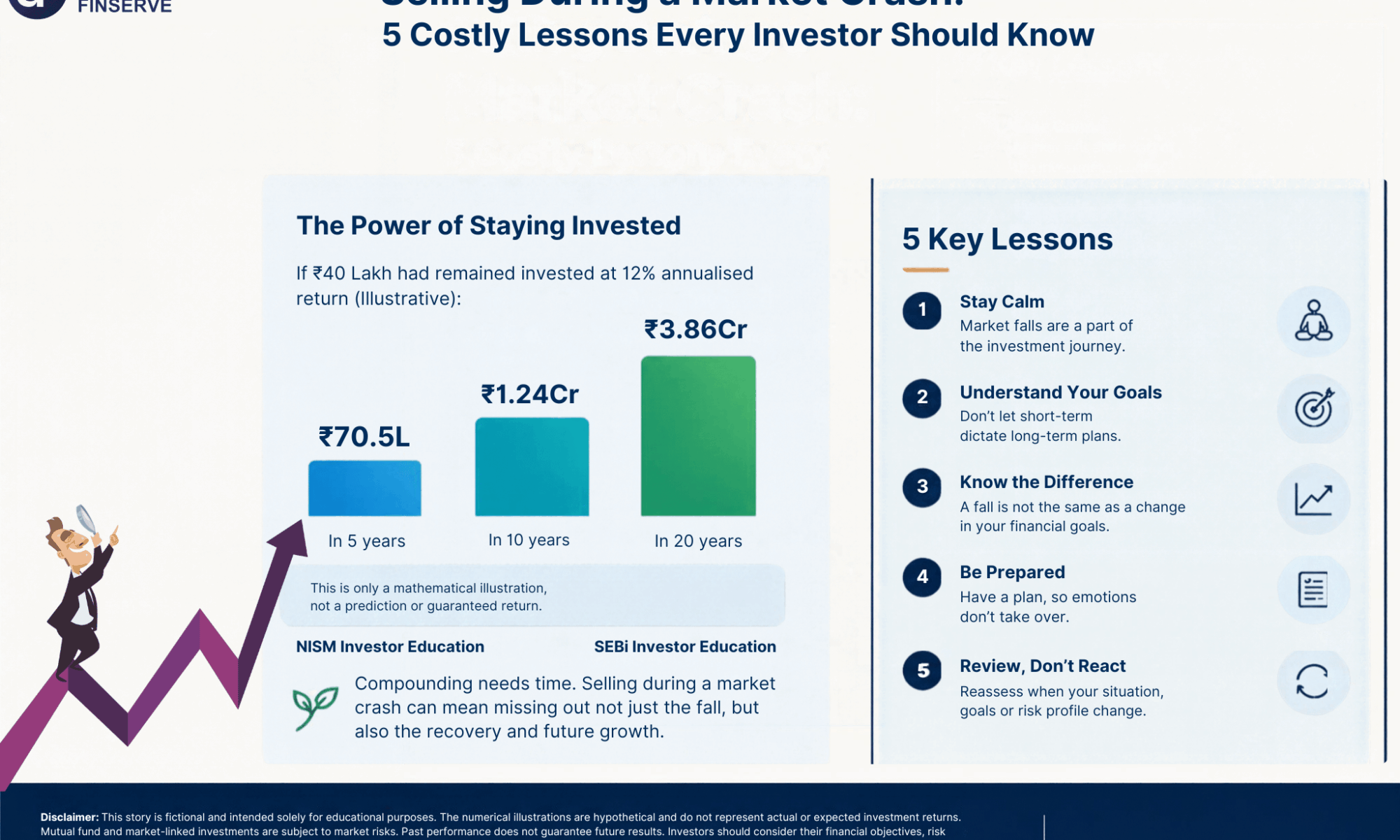
If Arjun’s ₹40 lakh had remained invested and earned an illustrative 12% annualized return, it could have grown to approximately ₹70.5 lakh in 5 years, ₹1.24 crore in 10 years, and ₹3.86 crore in 20 years.

(This is only a mathematical illustration, not a prediction or guaranteed return.)

Instead, if the ₹40 lakh simply remained as cash, it would still be approximately ₹40 lakh, ignoring interest, inflation, and taxes.

The important point is that compounding needs time—when an investor sells during a market crash, they may not just miss the fall, they can also miss the recovery and the future compounding that follows.

For more on how investment behavior can affect long-term outcomes, investors can also explore NISM’s educational material on disciplined investing and staying invested through market fluctuations. (NISM)

The Real Cost Wasn’t the Fall—It Was the Recovery He Missed

Consider an even simpler example.

Suppose an investor has ₹1 crore and the market falls by 30%.

The portfolio becomes ₹70 lakh.

To get from ₹70 lakh back to ₹1 crore, the portfolio needs to rise by approximately 42.9%, not 30%.

Now imagine the investor sells at ₹70 lakh.

If the market subsequently rises by 50%, the investor who stayed invested would have approximately ₹1.05 crore, while the investor who sold would still have ₹70 lakh if that money remained in cash.

This doesn’t mean investors should never sell—it simply shows why selling during a market crash can create another challenge: participating in the recovery.

Should You Never Sell?

Absolutely not—that would be the wrong lesson to take from this story.

There can be perfectly valid reasons to sell or reduce an investment: your financial goal has changed, your investment horizon has become shorter, your risk tolerance has changed, your circumstances are different, or the underlying investment case no longer fits your original plan.

These situations deserve a proper review.

The bigger concern is selling purely because the market is falling, without anything about your actual plan having changed.

Before selling during a market crash, ask yourself:

“If the market hadn’t fallen, would I still believe this portfolio is right for my long-term goal?”

If the answer is yes, your goal hasn’t changed—only the market value has.

That distinction can be important.

If you’re reviewing your mutual fund portfolio, you may also find our guide on Why Is My Mutual Fund Underperforming? useful for understanding whether underperformance is temporary or something that requires a deeper review.

GCIC Finserve’s Take

Arjun’s story is fictional, but the behavior behind it is something many Delhi NCR investors can relate to during difficult market cycles.

At GCIC Finserve, AMFI-registered Mutual Fund Distributor (ARN-272705), we believe investment decisions should be reviewed in the context of your financial goals, risk profile, investment horizon, and underlying investments—not simply because markets have temporarily fallen.

A market correction can be uncomfortable, but making a long-term decision during a short-term period of fear can have consequences.

Before selling during a market crash, take a step back and review whether your original plan has actually changed.

Investors can also refer to NISM’s investor-education resources for information on disciplined investing, financial planning, and understanding market fluctuations. NISM’s recent investor-education material specifically highlights disciplined investing and avoiding emotional decision-making during market cycles. (NISM)

For additional information about mutual fund risks, investors can refer to AMFI’s investor education resources. AMFI notes that mutual fund investments are subject to market-related risks and that returns are not guaranteed. (AMFI India)

If you’re unsure whether your portfolio still fits your goals, connect with GCIC Finserve or consider discussing your situation with a qualified financial professional before making a major investment decision.

FAQs

Q1. Is selling during a market crash ever a good idea?

It can be appropriate when your financial goals, investment horizon, risk tolerance, or the underlying investment have genuinely changed.

Selling purely because of short-term market fear, however, can make it difficult to participate in a subsequent recovery.

Q2. How much does a portfolio need to recover after a 30% fall?

A portfolio that falls 30% needs approximately a 42.9% gain to return to its original value.

Q3. Why do investors often miss the recovery after selling?

Markets don’t usually provide a clear signal telling investors exactly when the recovery has begun.

Investors waiting for “confirmation” may re-enter only after prices have already moved higher.

Q4. What should I ask myself before selling during a market crash?

Ask whether your original investment goal, time horizon, and reason for investing have changed.

If they haven’t, consider whether the decision is being driven mainly by short-term market fear.

Q5. Should I stop investing when the market falls?

There is no single answer for every investor.

The appropriate approach depends on your goals, risk profile, time horizon, and financial circumstances.

A market fall by itself does not automatically mean an existing investment plan is no longer suitable.

Final Word

A market fall is an event. Your response to it is a decision—and the two don’t necessarily have to be treated as the same thing.

Arjun didn’t need to predict the market bottom or buy at the lowest possible price.

He simply needed to understand the difference between a temporary market decline and a genuine change in his plan.

Sometimes, the biggest cost of selling during a market crash isn’t the loss you lock in—it’s the recovery and future compounding you may miss.

Disclaimer: This story is fictional and intended solely for educational purposes. The numerical illustrations are hypothetical and do not represent actual or expected investment returns. Mutual fund and market-linked investments are subject to market risks. Past performance does not guarantee future results. Investors should consider their financial objectives, risk profile, and investment horizon before making investment decisions. Please consult a qualified financial professional for advice specific to your circumstances.

Ronald Read Investor Story: The Janitor Who Built an $8 Million Fortune

Ronald Read investor story about a janitor who built an $8 million fortune through disciplined investing
The Ronald Read investor story highlights the power of disciplined investing, patience and long-term wealth creation.

The Ronald Read investor story is a powerful reminder that building substantial wealth isn’t always about earning a high income. Discipline, consistent saving, sensible investing, and time can also play an important role in long-term wealth creation.

Ronald Read worked as a gas station attendant and later worked as a part-time janitor at J.C. Penney in Brattleboro, Vermont. When he passed away in 2014 at age 92, his estate was reportedly worth around $8 million.

What made his story remarkable was not simply the amount of wealth he accumulated, but the quiet and disciplined way in which he built it.

Who Was Ronald Read?

Read came from modest beginnings, served in World War II, and lived a relatively simple life.

Over several decades, he saved and invested while maintaining a lifestyle far removed from the image many people associate with significant wealth.

After his death, a significant portion of his estate was donated to charitable causes, including Brattleboro Memorial Hospital and Brooks Memorial Library.

His story became a powerful example of how financial behavior can matter just as much as income.

The Real Lesson Behind the Ronald Read Investor Story

What makes this story relevant today is how the wealth was accumulated.

Read was reported to have invested in shares of established companies and held investments for long periods rather than constantly buying and selling based on short-term market movements.

His story illustrates an important principle:

Building wealth is not always about finding the next big opportunity. Sometimes it is about consistently making sensible decisions and giving them enough time to work.

A high salary can make investing easier, but income alone does not create financial security.

Saving, investing, controlling expenses, and maintaining a long-term perspective can all play an important role.

Key Takeaways for Indian Investors

1. Start early, even if you start small

Waiting until your income becomes significantly higher may mean missing valuable time for long-term investing and compounding.

Starting with an amount that fits your financial situation can help establish a consistent investing habit.

2. Think long term

Markets can experience periods of volatility, but long-term investing is fundamentally different from trying to predict every short-term movement.

3. Keep expenses under control

Living below your means can create more room for saving and investing.

4. Let time work

Compounding becomes increasingly powerful when investments remain invested for long periods.

For long-term investors, staying invested consistently may be more practical than trying to predict every short-term market movement.

How This Applies to Investors in Delhi NCR

For many families across Delhi NCR, wealth creation can sometimes feel like something reserved for people with very high incomes.

The Ronald Read story offers a different perspective.

A disciplined investment approach, when aligned with long-term financial goals, can help investors work toward building wealth over many years.

A Systematic Investment Plan (SIP) is a method of investing a fixed amount at regular intervals in a mutual fund scheme. The amount and investment approach should depend on an individual’s financial goals, time horizon, and risk tolerance.

The key lesson isn’t that every investor will achieve Ronald Read’s outcome.

It is that starting early, staying consistent, and giving investments sufficient time can make a meaningful difference.

Common Mistakes That Can Disrupt Long-Term Wealth Creation

  • Waiting for a higher salary before starting
  • Frequently changing investments because of market noise
  • Making decisions based purely on short-term market movements
  • Investing without clearly defined financial goals
  • Ignoring risk while focusing only on potential returns

Building Your Own Long-Term Wealth Plan

If you want to apply the principles from the Ronald Read story, start with a simple framework:

  1. Define your financial goals.
  2. Determine how much you can invest regularly.
  3. Choose investment options appropriate for your goals and risk tolerance.
  4. Stay focused on your long-term time horizon.
  5. Review your investments periodically rather than reacting to every market movement.

At GCIC Finserve, we help investors explore investment solutions based on their financial goals, investment horizon, and individual requirements.


The objective isn’t to chase every market opportunity. It is to build a disciplined approach that can remain aligned with your long-term financial journey.

Final Thoughts

The Ronald Read investor story isn’t simply about a million-dollar fortune. It is a story about discipline, patience, controlled spending, and the power of time.

You don’t need to look wealthy to be building wealth.

Sometimes the most important financial decisions are the ones nobody sees.

Want to explore investment solutions for your long-term goals?

Connect with GCIC Finserve.

FAQs

1. Who was Ronald Read?
Ronald Read was a US janitor and gas station attendant whose disciplined saving and long-term investing helped him build an estate reportedly worth around $8 million.

2. What can investors learn from the Ronald Read investor story?
The key lessons are starting early, investing consistently, controlling expenses, and staying focused on long-term goals.

3. Can Indian investors apply the lessons from Ronald Read’s story?
Yes. Indian investors can apply these principles through disciplined saving, suitable investment options, and a long-term approach aligned with their goals and risk tolerance.

4. How can GCIC Finserve help with long-term investment goals?
GCIC Finserve provides investment solutions based on financial goals, investment horizon, and individual requirements, helping investors explore suitable options for their long-term journey.


Disclaimer: Investments are subject to market risks. Past performance or historical examples do not guarantee future results. Please read all scheme-related documents carefully and consider your financial goals, investment horizon, and risk tolerance before investing.

Mutual fund monthly SIP inflow crosses Rs 25,000 crore mark for first time

SIP inflow crosses Rs 25k crore

SIP inflow crosses Rs 25k crore in October 2024, a notable increase from ₹24,509 crore in September. This is the first time SIP inflows have exceeded the ₹25,000 crore mark.

The number of new SIP registrations also saw significant growth, with 63.7 lakh new accounts in October, up from 58.7 lakh in September.

As a result, the total number of SIP accounts rose to 10.12 crore, reflecting a 2.5% increase from 9.87 crore in the previous month.

The total Assets Under Management (AUM) from SIPs reached ₹13.30 lakh crore in October, marking a 2.3% rise from ₹13.01 lakh crore in September. This growth comes amid a broader trend of rising equity inflows, with the mutual fund industry recording its 44th consecutive month of positive inflows.

The retail folios have now crossed 17.23 crore, with the total AUM standing at ₹67.26 lakh crore.

Anish Mehta, National Head of Sales, Marketing & Digital Business at Kotak Mahindra Asset Management, noted that investors are increasingly favoring large-cap funds, particularly in the current market environment. He observed, “Investors are recognizing the stability of large-cap funds, and there’s also a shift toward multi-cap and flexi-cap funds for a more balanced risk approach.”

Venkat Chalasani, CEO of AMFI, commented on the broader trend, saying, “October 2024 marks the 44th consecutive month of positive equity inflows, continuing since March 2021. This sustained momentum in SIPs and AUM is a testament to the growing maturity of Indian investors, who are focusing on long-term wealth creation through mutual funds.

Read Also: 5 Reasons why you need a Financial Distributor