
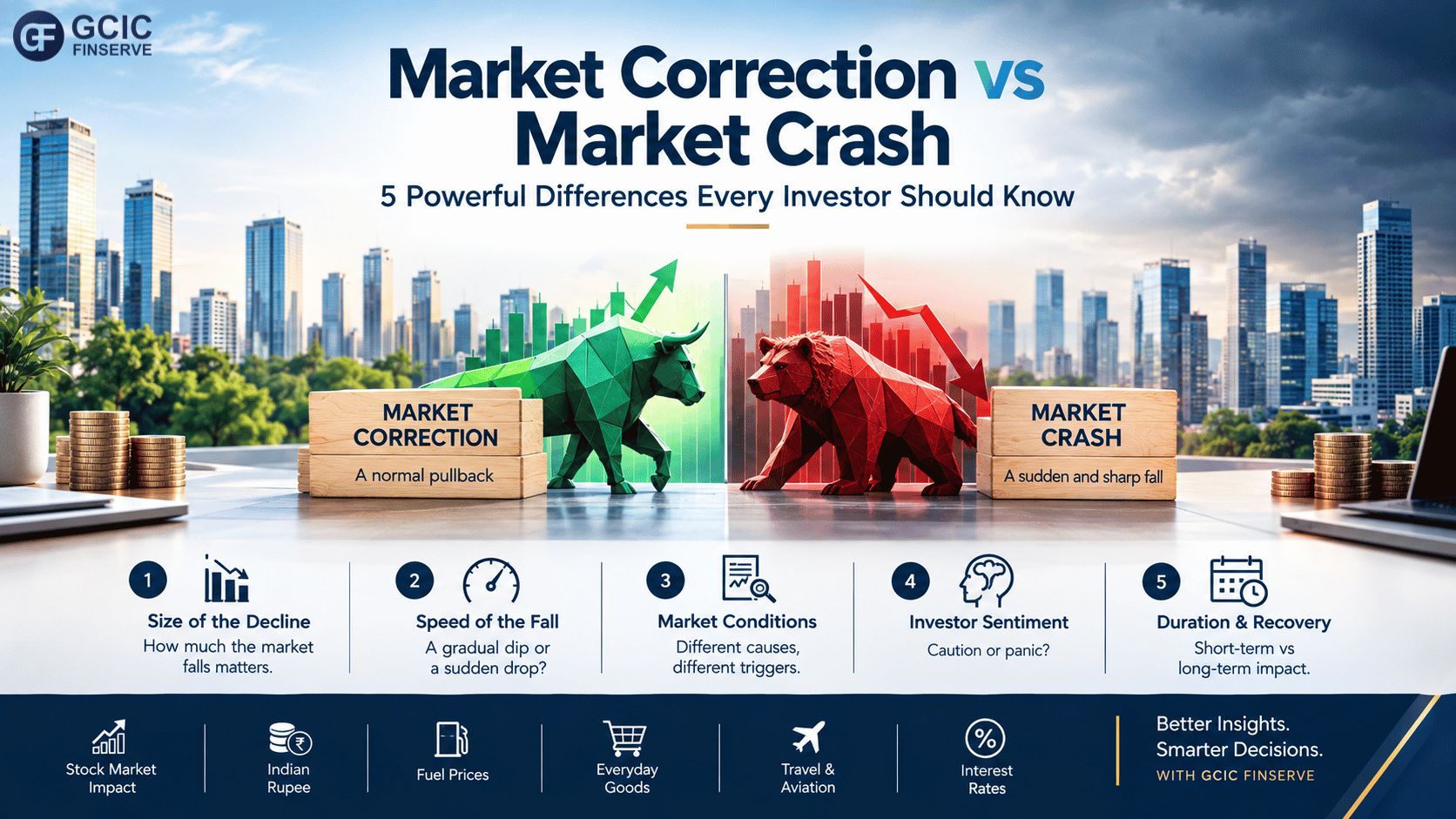

Market Correction vs Market Crash: 5 Powerful Differences Every Investor Should Know

market correction vs market crash explained for Indian investors
Market correction vs market crash: understanding the key differences can help investors navigate market volatility.

Market correction vs market crash—these terms are often used interchangeably whenever the Sensex or Nifty falls, but they describe different types of market movements. A correction generally refers to a decline from a recent peak, while a crash usually describes a sudden and severe fall over a short period.

For investors in Delhi, Gurugram, Noida, and the wider Delhi NCR region, understanding this difference can provide useful context when markets become volatile. Instead of reacting to headlines alone, it helps to look at the size, speed, underlying reasons, and potential impact of the decline.

What Is a Market Correction?

A market correction is a meaningful decline in the value of a stock market index after a period of growth.

NISM educational material describes a correction as a decline of 10% to 19.9% from a recent peak, while a decline of 20% or more is commonly used to describe bear-market territory. These are widely used market conventions rather than universal rules for every market situation.

For example, if the Nifty falls from 25,000 to 22,500, that represents a 10% decline.

A correction can happen for many reasons, including:

  • Profit booking after a strong rally
  • High market valuations
  • Changes in interest-rate expectations
  • Global economic uncertainty
  • Geopolitical developments
  • Changes in corporate earnings expectations
  • Foreign investor selling

A correction does not automatically mean that the long-term outlook for the economy or every company has changed.

What Is a Bear Market?

A bear market is generally a decline of 20% or more from a recent market peak.

NISM uses the 20% threshold when describing bear territory in its educational material.

However, the percentage alone does not explain why the market is falling.

A prolonged bear market can occur alongside concerns about economic growth, corporate earnings, liquidity, valuations, or investor confidence. Therefore, investors should look beyond the percentage decline and understand what is driving the market.

Market Correction vs Market Crash: 5 Key Differences

1. Size of the Decline

The first difference in the market correction vs market crash discussion is the extent of the fall.

A correction is commonly associated with a decline of 10%–19.9% from a recent peak. A decline of 20% or more is generally considered bear-market territory.

A crash, however, does not have one universally accepted percentage threshold.

This means that simply seeing the market fall does not automatically mean a crash is happening.

2. Speed of the Fall

Speed is one of the most important differences when comparing a market correction vs market crash.

A correction can develop over weeks or months. A crash is generally associated with a sudden and severe decline over a short period.

For example, a 15% decline spread across several months is different from a 15% fall occurring within a few trading sessions.

The speed of a decline can also influence investor behavior because sudden losses may lead to increased uncertainty and rapid selling.

3. Underlying Market Conditions

A correction may occur because markets have become expensive, investors are booking profits, or expectations have become too optimistic.

A crash can be associated with a sudden shock or a sharp deterioration in market confidence.

However, there is no single event that defines every market crash. Each episode has its own causes and circumstances.

This is why market correction vs market crash should not be judged only by the number shown on the index screen.

4. Investor Sentiment

Investor psychology can be another major difference.

During a correction, investors may become cautious while still expecting markets or businesses to recover over time.

During a sudden crash, fear can spread much faster. Investors may rush to reduce exposure, which can contribute to further short-term volatility.

Indian markets also have index-based market-wide circuit breakers at 10%, 15% and 20% movements in the Sensex or Nifty 50. When triggered, these can temporarily halt trading under specified rules.

5. Potential Duration and Recovery

A correction can be relatively short-lived, although there is no fixed recovery period.

A deeper market decline can take considerably longer to recover from. The recovery period depends on factors such as economic conditions, corporate earnings, valuations, liquidity, and investor confidence.

Therefore, in a market correction vs market crash situation, investors should avoid assuming that every fall will recover at the same speed.

A Simple Example

Imagine the Nifty is trading at 25,000.

Correction:
Nifty falls to 22,500—a 10% decline.

Bear-market territory:
Nifty falls to 20,000—a 20% decline from 25,000.

Crash:
The market experiences a sudden and severe decline over a short period because of a major shock.

The important point is that a crash is generally discussed in terms of speed and severity, rather than one fixed percentage.

What Should Investors Consider When Markets Fall?

When markets turn red, the first question is often, “Should I sell?”

A better starting point is to understand your own financial situation.

Consider these questions:

  • Has your financial goal changed?
  • Has your investment horizon changed?
  • Has your risk capacity changed?
  • Has your portfolio allocation become significantly different?
  • Has something fundamentally changed about the investment?
  • Are you reacting to information or simply to short-term market movement?

For investors holding mutual funds, reviewing the actual portfolio and investment objective can be more useful than reacting to an index headline. You can learn more about mutual fund investing through GCIC Finserve’s mutual fund investment solutions.

Similarly, a broader financial review can help investors understand whether their investments remain aligned with their goals. GCIC Finserve’s Financial Assessment & Investment Planning service covers financial goals and investment planning.

The key point in the market correction vs market crash discussion is that the label alone should not determine an investment decision.

GCIC Finserve’s Perspective for Delhi NCR Investors

At GCIC Finserve, we believe market movements should be understood in the context of an investor’s financial goals, investment horizon, risk profile, and overall portfolio.

For investors across South Delhi, Gurugram, Noida, and the wider Delhi NCR region, understanding why markets are falling can provide useful context before making changes to an investment strategy.

GCIC Finserve is an AMFI-registered Mutual Fund Distributor (ARN-272705).

Investors should consider their individual financial circumstances and investment objectives before making investment decisions.

FAQs

Q1. Is a 10% fall in the market a crash?

Not necessarily. A decline of 10%–19.9% from a recent peak is commonly described as a market correction. A crash does not have one universally accepted percentage definition.

Q2. Is a 20% fall considered a bear market?

A decline of 20% or more from a recent peak is the commonly used threshold for bear-market territory.

Q3. How much does the market need to fall to be called a crash?

There is no universally accepted percentage. A crash is generally associated with a sharp and rapid decline accompanied by significant market stress.

Q4. Should I stop my SIP during a market correction?

A market correction by itself does not automatically mean that an SIP should be stopped. Investors should consider their financial goals, investment horizon, cash-flow situation, and risk profile before making changes to an ongoing investment.

Q5. What is the main difference between a market correction and a crash?

A correction is generally a decline of 10%–19.9% from a recent peak, while a crash usually refers to a sudden and severe market fall. The distinction is not based on one universally accepted crash percentage.

Final Word

A correction is not automatically a crash, and a bear market does not necessarily mean a permanent loss.

Understanding market correction vs market crash can help investors put market declines into perspective. Instead of reacting to every red headline, consider the size and speed of the decline, the reason behind it, your investment horizon, financial goals, and overall portfolio.

For long-term investors, having a clear financial plan can provide a framework for dealing with periods of market volatility.

Disclaimer: This article is intended solely for educational and informational purposes and should not be construed as investment advice. Mutual fund investments are subject to market risks. Please read all scheme-related documents carefully before investing. Investors should consider their financial goals, risk profile, and investment horizon and consult an appropriately qualified/registered financial professional where required.

Why Is the Indian Stock Market Not Going Up? 7 Key Reasons Explained

Indian stock market
Indian stock market
Understanding the key factors influencing the Indian stock market.

The Indian stock market has spent much of the recent period struggling to build sustained upward momentum.

For long-term investors, that can be uncomfortable.

But a market that isn’t moving higher is not necessarily a market that is fundamentally broken.

Markets rarely move because of a single variable. They move when liquidity, earnings, valuations, interest rates, global risk appetite, and investor expectations interact with one another.

In the current market environment, several of those forces are creating pressure on Indian equities.

Here are seven factors investors should understand before making decisions based on the latest market movement.

  1. Crude Oil Has Become a Major Variable Again

For India, oil matters.

India imports the majority of the crude oil it consumes. When crude prices rise sharply, the impact can extend beyond petrol and diesel.

Higher crude prices can put pressure on:

  • India’s import bill
  • The current account
  • The Indian rupee
  • Inflation
  • Corporate input costs
  • Consumer purchasing power

With crude oil moving above the $100-per-barrel level amid heightened geopolitical tensions, investors have begun reassessing the potential inflationary and macroeconomic consequences.

The important point is not simply that “oil is expensive.”

It is whether higher oil prices remain elevated for long enough to affect economic expectations.

2. Foreign Investors Are Selling

Foreign Portfolio Investors (FPIs) remain an important source of liquidity for Indian equities.

When global investors reduce exposure to emerging markets, India can experience selling pressure even when domestic fundamentals remain relatively resilient.

The recent market environment has again highlighted this dynamic.

However, FPI selling should not automatically be interpreted as a verdict on India’s long-term economic prospects.

Foreign capital responds to several variables simultaneously:

Global interest rates → Dollar strength → Emerging-market risk → Valuations → Relative attractiveness

A foreign investor can reduce Indian equity exposure without believing that India’s long-term growth story has disappeared.

3. The Rupee Is Under Pressure

Currency movements are often overlooked by equity investors.

A weaker rupee can increase the domestic cost of imported commodities—particularly crude oil—creating another potential source of inflationary pressure.

It also changes the return profile for foreign investors.

This creates an interconnected chain:

Higher Oil → Higher Import Costs → Rupee Pressure → Inflation Concerns → Rate Expectations → Equity Valuations

Markets are currently pricing these relationships, not simply reacting to an individual headline.

4. Geopolitical Risk Is Increasing the Market’s Risk Premium

Markets dislike uncertainty.

The escalation of geopolitical tensions in the Middle East has introduced another variable into an already complicated macroeconomic environment.

The market does not need to know exactly what happens next to react.

Investors typically begin demanding a greater risk premium when uncertainty rises.

That can result in:

  • Lower equity valuations
  • Increased volatility
  • Rotation toward defensive assets
  • Reduced risk-taking
  • Greater sensitivity to negative news

This is one reason markets can remain subdued even when there is no single domestic economic crisis.

5. Valuations Matter

A strong company can still be an expensive investment.

India’s long-term growth story remains compelling, but investors cannot evaluate equities purely through the lens of economic growth.

The question is also:

How much future growth is already reflected in today’s prices?

When valuations are elevated, markets become more sensitive to disappointments.

If earnings grow slower than expected, interest rates remain higher for longer, or global risk appetite deteriorates, investors may be willing to pay lower multiples for the same earnings.

This is why good fundamentals and weak short-term markets can coexist.

6. Investors Are Waiting for Greater Clarity

Markets are ultimately forward-looking.

Investors are continuously trying to estimate what the next 6–18 months could look like.

At present, several questions remain open:

  • Where will crude oil settle?
  • How persistent will inflation be?
  • What happens to global interest rates?
  • How will the rupee behave?
  • Will foreign capital return?
  • Can corporate earnings meet expectations?

Until some of these variables become clearer, markets can remain range-bound or volatile.

Sometimes the absence of a strong upward catalyst is itself enough to keep markets from moving meaningfully higher.

7. The Market May Simply Be Digesting the Previous Rally

This is perhaps the least dramatic—and often the most overlooked—explanation.

Markets do not move in straight lines.

Periods of strong performance are frequently followed by periods of:

Consolidation → Profit Booking → Rotation → Repricing → Reaccumulation

A sideways market does not necessarily mean that the long-term investment thesis has failed.

It can simply mean that buyers and sellers are temporarily reaching equilibrium.

The market is reassessing expectations.

So, Is Something Fundamentally Wrong With the Indian Stock Market?

Not necessarily.

That distinction matters.

There is a difference between:

The market isn’t going up.

and

The underlying investment thesis has deteriorated.

They are not the same statement.

Markets can remain flat or decline because expectations were too optimistic, valuations were stretched, global liquidity changed, geopolitical risk increased, or investors simply became more cautious.

A weaker market does not automatically mean weaker long-term fundamentals. Investors should distinguish between short-term market sentiment and the underlying fundamentals of the businesses they own.

For a long-term investor, the appropriate response is therefore not to react to every movement in the index.

It is to determine whether your portfolio still makes sense relative to your goals, time horizon and risk capacity.

What Should Investors Do Right Now?

There is no universal answer.

A sensible framework is to ask five questions.

1. Has Your Financial Goal Changed?

If not, a short-term market movement may not require a change in strategy.

2. Has Your Investment Horizon Changed?

Money required in the near term should generally not be exposed to the same level of equity risk as long-term capital.

3. Has the Reason You Invested Changed?

If the underlying thesis has materially deteriorated, that deserves analysis.

4. Has Your Asset Allocation Drifted?

Market movements can cause your portfolio to become more aggressive or defensive than originally intended.

Are You Reacting to Information—or Emotion?

This is perhaps the most important question.

A market decline can create an overwhelming urge to do something.

But sometimes the most rational decision is to review rather than react.

The Bigger Picture for the Indian Stock Market

The Indian market’s current weakness is being shaped by a combination of oil, geopolitics, foreign flows, currency pressure, valuations, and uncertainty.

None of these factors should be viewed in isolation.

More importantly, none of them can reliably tell an investor where the market will be tomorrow.

That is not the objective of investing.

The objective is to construct a portfolio capable of surviving periods when markets do not cooperate with our expectations.

Because wealth is rarely built by predicting every market move.

It is built by having a strategy that can withstand them.

GCIC Perspective

A stagnant market is not necessarily a signal to stop investing.

It is a signal to pay closer attention to what actually drives your portfolio.

Instead of asking:

When will the market go up?

A more useful question may be:

Is my portfolio positioned appropriately for the goals I am investing for?

The first question requires a prediction.

The second requires a plan.

At GCIC Finserve, we believe long-term investing should be guided by financial objectives, appropriate asset allocation, and discipline—not by the latest movement in the market.

Disclaimer: This article is intended solely for educational and informational purposes and should not be construed as investment advice, a recommendation, or a solicitation to buy or sell any security or investment product. Mutual fund investments are subject to market risks. Investors should consider their financial objectives, risk profile, and investment horizon and review relevant scheme documents before investing.

Bajaj Finance, Axis Bank, HDFC Bank Rally Up to 6% on S&P Upgrade and GST Reform Hopes

GST Reform

Bajaj Finance shares rallied sharply in early trade on Monday, gaining as much as 6% alongside Axis Bank and HDFC Bank as investor sentiment improved following S&P Global’s credit-rating upgrades and expectations of GST reforms.

At 10:10 a.m., the Nifty Bank index climbed over 1.3% to around 56,035, while the Nifty Financial Services index gained nearly 2% to trade near 26,810. Bajaj Finance, Axis Bank, and HDFC Bank were among the top gainers, supported by strong buying across the financial sector.

S&P Upgrade Lifts Sentiment

S&P Global on Aug. 15 upgraded its long-term issuer credit ratings for seven major Indian banks — including SBI, ICICI Bank, HDFC Bank, Axis Bank, Kotak Mahindra Bank, Union Bank of India, and Indian Bank — and three finance companies: Bajaj Finance, Tata Capital, and L&T Finance. The rating agency cited India’s robust economic momentum, improved asset quality, and strong profitability outlook for the financial sector.

“We expect India’s banks to maintain adequate asset quality, good profitability, and enhanced capitalization over the next 12-24 months despite some pockets of stress,” S&P said, adding that overall credit risk has declined. The move comes just a day after S&P upgraded India’s sovereign credit rating, providing a further boost to investor sentiment.

Motilal Oswal Financial Services noted that the upgrade could reduce borrowing costs for Indian financial firms accessing overseas markets. Companies such as Bajaj Finance could see a 15–20 basis point reduction in external commercial borrowing rates, while stronger foreign portfolio investment flows may support the rupee and bond yields.

GST Reform Expectations Add Fuel

Investor enthusiasm was also buoyed by Prime Minister Narendra Modi’s Independence Day hint at a new round of GST reforms, potentially to be unveiled around Diwali. The government is reportedly considering a simplified two-slab tax structure — “standard” and “merit” — with special rates limited to a few items.

Analysts believe such reforms could lower the tax burden on consumers purchasing electronics and other durables, spurring demand. This is expected to benefit NBFCs like Bajaj Finance, which finance retail purchases through affordable EMIs.

The dual tailwinds of a global rating upgrade and anticipated tax reforms have positioned India’s financial stocks for continued momentum, analysts say, as foreign and domestic investors alike increase exposure to the sector.

Nifty 50 Surges Over 400 Points, Sensex Reclaims 80K: Experts Highlight Top Stock Picks

Nifty 50 Surges Over 400 Points

Nifty 50 surges over 400 points as the Indian stock market opened strongly at the start of the week, extending the momentum from Friday’s rebound. The Nifty 50 opened at 24,253 and climbed to an intraday high of 24,330, representing a 423-point rise from its previous close of 23,907.

The BSE Sensex also regained the 80,000 mark, opening at 80,193 and reaching 80,452 during the morning session. The Nifty Bank index posted strong gains as well, reflecting broad-based buying interest across key sectors.

Nifty 50 Surges: Factors Driving the Rally

Political Stability After Maharashtra Election Results
The decisive victory of the BJP-led alliance in Maharashtra’s elections played a crucial role in boosting investor sentiment. According to Palka Arora Chopra, Director at Master Capital Services, the win is expected to bring political stability and strengthen pro-business policies, positively influencing sectors such as infrastructure, urban development, and manufacturing.

“The continuity of policy direction, particularly in infrastructure development, is likely to attract further investments. This could lead to significant activity in the construction and real estate sectors,” Chopra added.

Reliance’s Strong Performance Amid Geopolitical Tensions
Reliance Industries, a heavyweight in the Sensex, gained around 2.5% during early trade. Mahesh M. Ojha, AVP at Hensex Securities, attributed this to rising crude oil prices driven by escalating geopolitical tensions. The company is poised to benefit from increased margins on existing stockpiles, along with continued growth in its retail and telecom businesses.

“Reliance looks strong for both short-term and long-term investors, given the positive trends in its core and diversified operations,” Ojha noted.

Sectoral Outlook

The election results have shifted investor focus from defensive sectors like FMCG and pharma to more aggressive plays in railways, infrastructure, and banking.

Avinash Gorakshkar, Head of Research at Profitmart Securities, observed that government initiatives in infrastructure and railways could drive demand in these sectors. Additionally, increased credit demand from infrastructure projects is likely to benefit banking stocks.

“The alignment of policies between the central and Maharashtra state governments ensures a conducive environment for growth in these sectors,” Gorakshkar stated.

As the market gains momentum, experts suggest keeping an eye on infrastructure, banking, and energy sectors for potential opportunities.

Read Also: Mutual fund monthly SIP inflow crosses Rs 25,000 crore mark for first time