

What Happens to Your Investments After You ? 7 Key Steps Every Delhi NCR Family Should Know

Family reviewing investment documents and estate planning records together
Understand nominations, Wills and investment transmission to help your family prepare.

You may have mutual funds across several folios, shares in a demat account, fixed deposits with different banks, insurance policies, bonds, and property. Your family may know these assets exist, but that does not necessarily mean they can claim or access them easily.

Understanding investment transmission, nomination, and succession planning can help your loved ones avoid unnecessary paperwork, delays, and uncertainty during an already difficult time.

In this guide, GCIC Finserve explains what happens to your investments after you die, how nominees and legal heirs differ, why a will matters, and what Delhi NCR families can do to keep their financial records organised.

1. Your Investments Don’t Simply Disappear

When an investor passes away, their investments generally need to be transferred, claimed, or settled through the applicable institutional and legal processes.

The process depends on several factors, including

  • Whether a nominee was registered.
  • Whether the investment was held individually or jointly.
  • Whether a valid will exists.
  • The type of investment and the institution holding it.
  • Whether there are disputes over ownership or inheritance.

For example, a family may know that a deceased relative owned mutual funds but not know the folio numbers, the asset management companies involved, or the documents needed to submit a claim.

This is why understanding what happens to your investments after you die is an important part of financial planning. Building wealth is only one part of the process; making your assets identifiable and keeping your records organised can also help your family.

2. Nominee vs Legal Heir: What’s the Difference?

A nominee is a person registered with a financial institution to receive or claim an asset following the investor’s death, subject to the applicable rules.

A legal heir is a person entitled to inherit an asset under the relevant succession law. A beneficiary named in a valid will may also have rights under the applicable law.

These roles can overlap, but they are not necessarily identical.

For example, a father may nominate his daughter for his mutual fund investments. After his death, she may be able to complete the fund house’s transmission process and have the units transferred to her. However, the question of ultimate beneficial ownership may depend on the applicable law, the will, the family circumstances, and other relevant facts.

Nomination should therefore not be treated as an automatic replacement for succession planning.

What should investors do?

  • Check nominations across all financial institutions.
  • Keep details of joint holders up to date.
  • Prepare or review a will where appropriate.
  • Seek qualified legal advice if family circumstances or ownership arrangements are complex.

The applicable rules can differ between mutual funds, demat securities, bank deposits, and insurance policies. Do not assume that the process for one asset automatically applies to another.

3. What Is the Role of a Will?

A Will records how a person intends their assets to be distributed after death, subject to applicable law and the Will’s validity.

It can cover assets such as:

  • Mutual fund investments.
  • Shares and other securities.
  • Bank deposits and fixed deposits.
  • Bonds and other financial assets.
  • Property and other personal possessions.

A will can be particularly useful when someone has multiple investments, dependants, or a family situation that requires clear instructions.

However, simply writing a will is not the whole process. It should be properly prepared, signed, and witnessed in accordance with applicable legal requirements, kept accessible, and reviewed when circumstances change.

For example, marriage, the birth of a child, a change in family responsibilities, or a significant change in wealth may be reasons to review your estate-planning arrangements.

If you are unsure how to prepare a will or how it interacts with nominations, consult a qualified legal professional.

4. What Happens to Mutual Funds, Shares, FDs, and Insurance?

Different investments have different procedures for claims and transmission after an investor’s death.

Mutual Funds

Mutual fund units are generally transferred through a process known as transmission.

Where a nominee is registered, the nominee can generally initiate the process by submitting the required documents to the relevant asset management company or its registrar and transfer agent.

Depending on the circumstances, documents may include a death certificate, claim forms, KYC information, and other prescribed evidence.

Where there is no nominee, legal heirs or an eligible legal representative may need to establish their entitlement and provide additional documents.

Joint holdings may follow a different process depending on the holding arrangement and applicable requirements.

For official investor information, refer to AMFI India.

Shares and Demat Accounts

Shares held in a demat account are handled through the applicable depository, depository participant and transmission procedures.

The process depends on whether the account was held individually or jointly and whether a valid nomination exists. Additional documents may be required in certain cases.

Families should identify the relevant demat accounts and contact the depository participant for the current requirements.

For official information, visit SEBI.

Fixed Deposits and Bank Accounts

Banks have procedures for settling claims involving deceased depositors.

The documents and steps required may depend on whether the account has a nominee, whether it is jointly held, and whether any dispute or competing claim exists.

Families should contact the relevant bank and follow its current deceased-depositor claim procedure. Nomination and joint-account arrangements can simplify the process, but they do not resolve every possible succession issue.

For official banking information, visit the Reserve Bank of India.

Insurance Policies

Insurance claims are governed by the policy terms and applicable insurance law.

The insurer may require a death certificate, claim form, policy details, identity documents, and other supporting records. The rights of a nominee, assignee, or other claimant depend on the policy and the applicable legal provisions.

Families should contact the insurer directly to confirm the requirements.

For official insurance information, visit the Insurance Regulatory and Development Authority of India.

Important: The process, documents, and timelines can differ by institution and individual circumstances. Always confirm the current requirements with the relevant institution.

5. What If Your Family Doesn’t Know About Your Investments?

Imagine someone who has eight mutual fund folios, two demat accounts, four bank accounts, six fixed deposits, three insurance policies, and property.

Their family may know that the person was financially successful but have no clear idea where every asset is held.

In such cases, the challenge may not be that the money has disappeared. The challenge is identifying the assets and establishing the right to claim them.

An investment inventory can help prevent this problem.

Your inventory can include:

  • Name of the bank, mutual fund house, insurer, or other institution.
  • Folio number or account reference.
  • Type of investment.
  • Registered nominee or joint holder, where applicable.
  • Location of important statements and documents.
  • Contact details or instructions for reaching the institution.

You do not need to include account passwords in this inventory. Keep sensitive information secure and tell a trusted family member or appropriate representative where the records can be found.

A simple, updated list can make a significant difference when your family needs to locate financial assets.

6. What If There Is No Nominee or a Family Dispute?

Having no registered nominee does not automatically mean that an investment is lost.

Eligible legal heirs or another person legally entitled to make the claim may be able to initiate the applicable process. However, the institution may require additional documentation to establish entitlement.

Depending on the asset and circumstances, this may include:

  • Death certificate.
  • Claim forms and KYC documents.
  • Proof of relationship or legal-heir status.
  • A Will, where relevant.
  • Indemnity, declarations or other prescribed documents.
  • Probate, letters of administration or succession-related documents where applicable.

Not every claim requires every document listed above. Requirements vary by institution, asset type, applicable law, and whether there is a dispute.

If family members disagree over the validity of a will, ownership of an asset, or entitlement to inherit, the process may become more complicated and may require legal assistance.

This is why nomination, organised records and succession planning should be considered together rather than as separate tasks.

7. A Simple 7-Step Investment Succession Checklist

You do not need to complete every part of your estate planning in one day. Start with these seven practical steps.

Step 1: List your assets

Create a list of your mutual funds, shares, bank accounts, fixed deposits, insurance policies, bonds, property, and other significant assets.

Step 2: Check every nomination

Review nomination details separately for each relevant institution. Updating a nominee for one investment does not automatically update the nomination for your other assets.

Step 3: Review joint holdings

Check how each jointly held account or investment is structured and understand the applicable process if one holder passes away.

Step 4: Prepare or review your will

Consider whether a will would help clarify your intentions. Obtain legal advice if you have complex assets, dependants, or family circumstances.

Step 5: Create an investment inventory

Record institution names, folio or account references, nominee details, and the location of important documents.

Step 6: Tell your family where the records are kept

Your family should know how to locate the information and whom to contact. Keep sensitive financial information secure rather than sharing passwords casually.

Step 7: Review everything periodically

Revisit your records and nominations after major family or financial changes and at regular intervals.

Taking these steps can help make your financial arrangements easier for your family to understand and navigate.

GCIC Finserve’s Perspective for Delhi NCR Families

Financial planning is not only about selecting investments. Keeping financial records organised and reviewing nomination details are also important parts of managing your investments responsibly.

At GCIC Finserve, an AMFI-registered Mutual Fund Distributor (ARN-272705), we support investors with mutual fund-related service requirements, including assistance with nomination details and folio records, subject to the applicable procedures.

For families in South Delhi and the wider Delhi NCR region, maintaining clear investment records can be a useful step towards better financial organization.

Legal matters, including drafting a will, determining inheritance rights and resolving succession disputes, should be discussed with a qualified legal professional.

Need assistance with your mutual fund records?

Visit GCIC Finserve to connect with our team regarding mutual fund-related service support.

For official mutual fund investor information and transmission guidance, visit AMFI India.

Frequently Asked Questions

Q1. Does a nominee automatically become the owner of my investments?

Not necessarily. A nominee’s role and the rights of legal heirs can differ depending on the type of asset, applicable law, ownership structure, and other circumstances. Nomination should not be assumed to settle every inheritance question.

Q2. Does nomination replace a will?

No. Nomination and a will serve different purposes. Nomination helps facilitate the relevant institutional claim or transmission process, while a Will records how a person intends their estate to be distributed, subject to applicable law.

Q3. What happens to mutual funds if there is no nominee?

Eligible legal heirs or a legally authorised representative may be able to claim or receive transmission of the mutual fund units after providing the required documents. The exact procedure depends on the circumstances and the fund house’s applicable requirements.

Q4. Can my family access my investments without my passwords?

Generally, legitimate claims are made through the institution’s prescribed process rather than by using the deceased person’s login credentials. The family will need to establish its entitlement and provide the required documents. Keeping a record of the institutions and accounts can help.

Q5. How often should I review my nominees?

Review nominations periodically and whenever there is a significant family or financial change, such as marriage, the birth of a child, the death of an existing nominee, or a change in your intended arrangements.

Q6. What happens to fixed deposits when the account holder dies?

The bank follows its applicable deceased-depositor claim procedure. The steps depend on nomination, joint-account arrangements, and the circumstances of the claim. Contact the relevant bank for its current requirements.

Q7. How can I help my family find all my investments?

Maintain an updated investment inventory containing institution names, folio or account references, relevant nominee information, and the location of important documents. Store it securely and tell a trusted person how to locate it.

Final Thoughts

Investing is usually discussed in terms of returns, risk, diversification, and compounding. But understanding what happens to your investments after you die is another important part of responsible financial planning.

A well-organized portfolio should not only reflect your financial goals; it should also be identifiable, supported by appropriate records, and managed with your family’s future needs in mind.

Review your nominations, keep an investment inventory, consider whether you need a will, and seek professional guidance where necessary.

Your family should not have to discover your entire financial life while dealing with the loss of a loved one.

A little preparation today can help reduce uncertainty for your family tomorrow.



Disclaimer: This article is for general educational and informational purposes only and does not constitute legal, financial, investment, or tax advice. Nomination, transmission, succession, and inheritance rules depend on the asset, applicable law, ownership structure, the existence and validity of a will, and individual circumstances. Procedures and requirements may change. Please consult the relevant financial institution and a qualified legal professional for advice specific to your situation.

Why Do You Need a Wealth Partner? 6 Signs Every Growing Delhi NCR Investor Should Watch For

Wealth partner helping an investor organize and manage multiple financial goals
A wealth partner can help bring investments, goals, and financial decisions together.

Why do you need a wealth partner? It’s a question that rarely comes up when you’re just starting out—a few SIPs, a bank account, maybe an insurance policy, and time doing the rest of the work. But as income grows across Delhi NCR’s fast-moving professional and business circles, financial lives rarely stay that simple. Money starts sitting across different institutions—a business, property, insurance, and retirement assets—and the question quietly shifts from “where should I invest?” to “how should all of my wealth work together?”

What Does a Wealth Partner Actually Mean?

At its core, the idea behind why you need a wealth partner comes down to one distinction: managing investments versus managing wealth. An investment is one piece of your financial life; understanding how all those pieces fit together—liquidity, risk, goals, asset allocation—is the broader picture.

Choosing a mutual fund answers where to invest ₹10 lakh. A wider conversation also asks, how much of your total wealth should stay liquid? Are you overexposed to one asset class? How should the portfolio evolve as goals get closer?

Why Do You Need a Wealth Partner as Your Finances Grow?

India’s investment landscape has expanded dramatically, which is part of why the wealth-partner conversation matters more today. According to AMFI India, the mutual fund industry’s assets under management grew from ₹15.63 lakh crore in August 2016 to ₹87.08 lakh crore by August 2026, with folios crossing 28.35 crore.

Investors today can choose from mutual funds, PMS, AIFs, SIFs, bonds, FDs, REITs, and InvITs—more choice, but not necessarily easier decisions.

The real challenge isn’t accessing investments anymore; it’s deciding which ones actually deserve a place in your financial life.

From Products to a Portfolio

Consider someone holding ten different mutual funds. Each may look reasonable individually, but that alone doesn’t confirm the portfolio makes sense—there could be significant overlap, too much exposure to one segment, or insufficient liquidity.

This is exactly where the question of why you need a wealth partner starts to matter: someone who looks beyond individual products and asks what the portfolio as a whole is actually trying to achieve.

From Investments to Decisions

Markets rise and fall, interest rates shift, and personal circumstances change. The hard part usually isn’t knowing what happened—it’s deciding what to do about it.

Should you rebalance? Deploy a cash surplus now or gradually? Move money just because something else recently performed better?

A structured process around these decisions—rather than reacting to headlines—is one of the clearest reasons investors consider professional financial support as their financial life becomes more layered.

What Areas Does This Kind of Support Cover?

The exact scope varies, but typically spans portfolio planning, asset allocation, goal planning, portfolio reviews, identifying concentration or overlap, risk and liquidity management, and rebalancing.

As financial circumstances become more complex, family wealth and succession considerations may also become relevant. Tax, legal, and estate matters usually require separate specialist professionals—coordination across these areas can still be an important part of the broader financial picture.

6 Signs You Might Need a Wealth Partner

  1. Your financial situation has become hard to track on your own—multiple institutions, products, or accounts.
  2. Your investable surplus has grown significantly and now needs a clearer structure.
  3. You have both business and personal wealth that rarely get looked at together.
  4. You’re approaching a major goal—retirement, a child’s education, or a large purchase.
  5. You’re unsure whether your portfolio is genuinely diversified or just spread across many products.
  6. You find yourself making investment decisions reactively, based on headlines rather than a plan.

The real question isn’t “How much money do I have?”—it”‘s “How much financial complexity am I comfortable managing myself?”

You Don’t Need One Just Because You Have Money

This distinction matters.

If your finances are straightforward and you have the time, interest, and discipline to manage everything yourself, doing it independently can work perfectly well.

The need typically emerges from complexity, not net worth alone. Someone with modest wealth but several overlapping goals may value structured support more than someone financially sophisticated with a simple, well-understood portfolio.

GCIC Finserve’s Perspective for Delhi NCR Investors

At GCIC Finserve, an AMFI-registered Mutual Fund Distributor (ARN-272705) and APMI-registered PMS Distributor (APRN-08140), we help Delhi NCR investors and families understand their mutual fund and PMS investment options and how these may fit within their broader financial goals and circumstances.

The appropriate approach depends on individual objectives, risk profile, investment horizon, and financial situation.

Connect with our team to discuss your investment requirements and available options.

FAQs

Q1. Is a wealth partner the same as a mutual fund distributor?

Not necessarily. A mutual fund distributor primarily facilitates and services mutual fund investments, while “wealth partner” is a broader term. The exact services and regulatory permissions depend on the specific entity and its registrations.

Q2. Is a wealth partner only for high-net-worth individuals?

No. The need depends more on the complexity of your finances than your net worth alone. Someone with modest wealth but several goals may value structured support just as much.

Q3. Does working with a wealth partner mean giving up control of my investments?

Not necessarily. The structure depends on the services involved. Investors can retain decision-making authority while using professional support for research, planning, and review.

Q4. Can a wealth partner guarantee better investment returns?

No. Returns can never be guaranteed. The value of professional support can lie in portfolio construction, risk management, goal alignment, and disciplined decision-making—not guaranteed return maximization.

Q5. When should I start thinking about this kind of support?

There’s no fixed number. A useful trigger is increasing complexity: more assets, more goals, or more decisions than you’re comfortable managing alone.

Final Word

Why do you need a wealth partner? Ultimately, it comes down to one shift: from making money work to making all of your money work together.

As your financial life across Delhi NCR grows—more assets, more goals, more decisions—the value isn’t necessarily in finding the next best investment alone, but in keeping every piece of your financial picture aligned with what you actually want it to achieve.


Disclaimer: This article is intended for educational and informational purposes only and should not be construed as investment advice, a recommendation, or a solicitation to invest in any particular financial product. Investment decisions should be based on individual financial circumstances, objectives, risk profile, and investment horizon. Past performance is not indicative of future results. Please independently evaluate products and, where appropriate, seek advice from suitably qualified and regulated professionals.

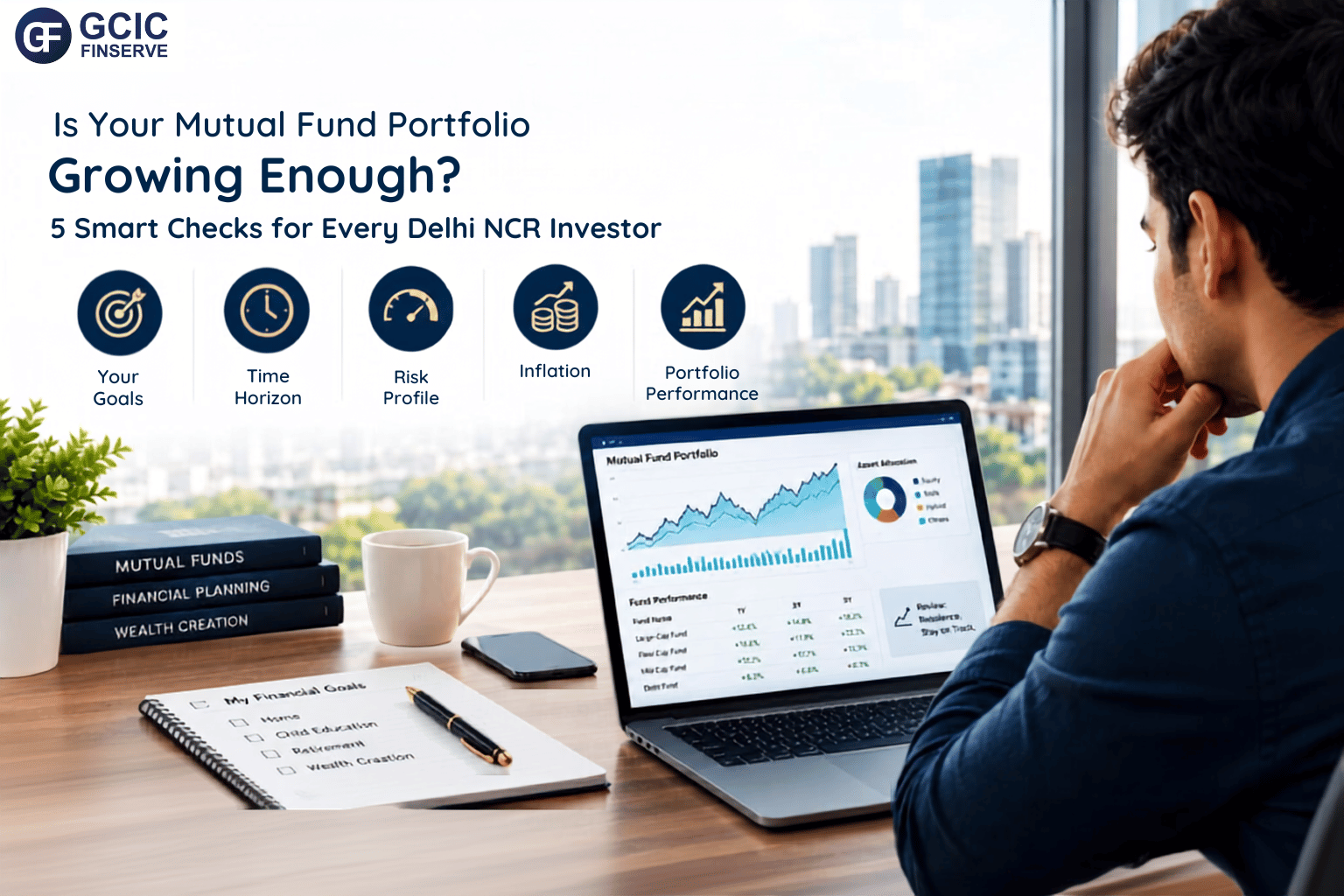
Is Your Mutual Fund Portfolio Growing Enough? 5 Smart Checks Every Delhi NCR Investor Should Run

mutual fund portfolio growing enough for long term financial goals
Is your mutual fund portfolio growing enough to support your financial goals?

Is your mutual fund portfolio growing enough—or just growing? Most investors in Delhi NCR know exactly how much their portfolio is worth today, but far fewer stop to ask if it’s growing at the rate they actually need. Watching your money move from ₹20 lakh to ₹25 lakh feels encouraging, but if that growth is genuinely “enough,” it depends entirely on what the money is meant to fund, when you’ll need it, and how much your goal will actually cost by then.

What Does “Growing Enough” Really Mean?

There’s no universal number that makes a return “good” for every investor. Someone investing for retirement 20 years away and someone saving for a house in Gurugram in 3 years could both have ₹25 lakh invested—yet their portfolios need to behave completely differently. If a mutual fund portfolio is growing enough depends on your financial goal, time horizon, inflation, current corpus, ongoing contributions, and risk profile. A portfolio should never be judged in isolation—only against the job it’s actually meant to do.

Why Inflation Matters for Your Mutual Fund Portfolio

Inflation is one of the biggest reasons Delhi NCR investors underestimate how much they truly need. If you want ₹1 crore for a goal 15 years away and inflation averages around 6%, the purchasing power of that ₹1 crore today could require closer to ₹2.4 crore by the time you reach your goal. So the real question isn’t “Can I build ₹1 crore?”—it’s “How much will my goal actually cost when I get there?” Your strategy should be based on this future value, not today’s price tag.

Don’t Judge a Single Year’s Return

Mutual fund returns swing considerably year to year, especially in equity. A portfolio might deliver 15% one year, dip 8% the next, and recover strongly after that. Looking only at the last 12 months can give a misleading picture of whether your mutual fund portfolio is growing enough. For long-term investors, metrics like CAGR, rolling returns, and XIRR—particularly useful for SIP investors since money enters at different points in time—offer a far more honest read of your actual trajectory.

Your Mutual Fund Portfolio Doesn’t Have to Beat the Nifty

A common mistake is comparing every portfolio against the Nifty 50. If the index delivers 14% and your portfolio delivers 11%, that doesn’t automatically mean it has underperformed. The Nifty 50 represents a specific set of large-cap companies, while your portfolio may hold a mix of large-cap, mid-cap, and debt funds designed to balance growth with stability. The more meaningful comparison runs from your portfolio to an appropriate benchmark to category performance and finally to the return your specific goal actually requires.

The Return You Need Is More Important Than the Return You Want

There’s a real difference between “what’s the highest return I can chase?” and “what return does my plan actually need?” If your goal requires an average of 10% over 15 years, chasing funds that recently delivered 18–20% may mean taking on far more risk than necessary. On the flip side, if your portfolio is tracking closer to 6% while your plan needs 10%, staying invested without a review could leave your mutual fund portfolio short of the target. The objective isn’t maximum return at any cost—it’s a reasonable return for the risk your goal actually requires.

5 Smart Checks: Is Your Mutual Fund Portfolio Growing Enough?

  1. What is this portfolio meant to achieve? Every investment should have a defined purpose.
  2. How much will I actually need? Factor in inflation and any changes to your goal’s future cost.
  3. How much time do I have? A 15-year horizon is evaluated very differently from a 3-year one.
  4. What return does my plan require? Work backwards from your goal instead of chasing an arbitrary number.
  5. Am I on track? Compare your current corpus and contribution rate against what you’re likely to need.

If your answer to that final question is no, identify why before switching funds impulsively—it could simply mean investing a little more each month rather than chasing a “better” fund.

When Should You Actually Be Concerned?

A slow-growing portfolio isn’t automatically a problem, but a proper review becomes important if you notice consistent underperformance against an appropriate benchmark, an asset allocation that no longer matches your goals, excessive concentration in one fund or sector, a major change in your financial circumstances, or a goal approaching without sufficient capital built up. According to AMFI’s investor education resources, reviewing your fund’s category and benchmark performance periodically—rather than reacting to short-term swings—is a healthier way to judge whether your mutual fund portfolio is growing enough.

GCIC Finserve’s Perspective for Delhi NCR Investors

At GCIC Finserve, we help Delhi NCR clients look beyond the headline return and ask the more important question: is your mutual fund portfolio genuinely growing enough for the life you’re planning? As an AMFI-registered Mutual Fund Distributor (ARN-272705), our team helps map your current investments against your real goals, time horizon, and risk profile. Book a portfolio review with our team before deciding whether your investments need a change.

FAQs

Q1. What is considered a good return for a mutual fund portfolio? There’s no universal number—it depends on your goal, time horizon, inflation, contributions, and risk profile.

Q2. Should my mutual fund portfolio always beat the Nifty 50? No. A diversified portfolio may have a different asset mix, so it should be compared against an appropriate benchmark, not just the index in the news.

Q3. How do I know if my mutual fund portfolio is growing enough? Compare your current corpus and monthly contributions against what your goal will realistically cost, factoring in inflation and your remaining time horizon.

Q4. How often should I review my mutual fund portfolio? A periodic review—rather than daily monitoring—helps confirm your investments, allocation, and goals remain aligned.

Final Word

The next time you check your investments, don’t just ask, “How much did I make?” Ask instead, “Is my mutual fund portfolio growing enough for where I actually want to go?” That’s the number that matters far more than last year’s headline return.


Disclaimer: This article is intended solely for educational and informational purposes and should not be construed as investment advice. Mutual fund investments are subject to market risks. Please review scheme-related documents and consult a registered advisor before investing.