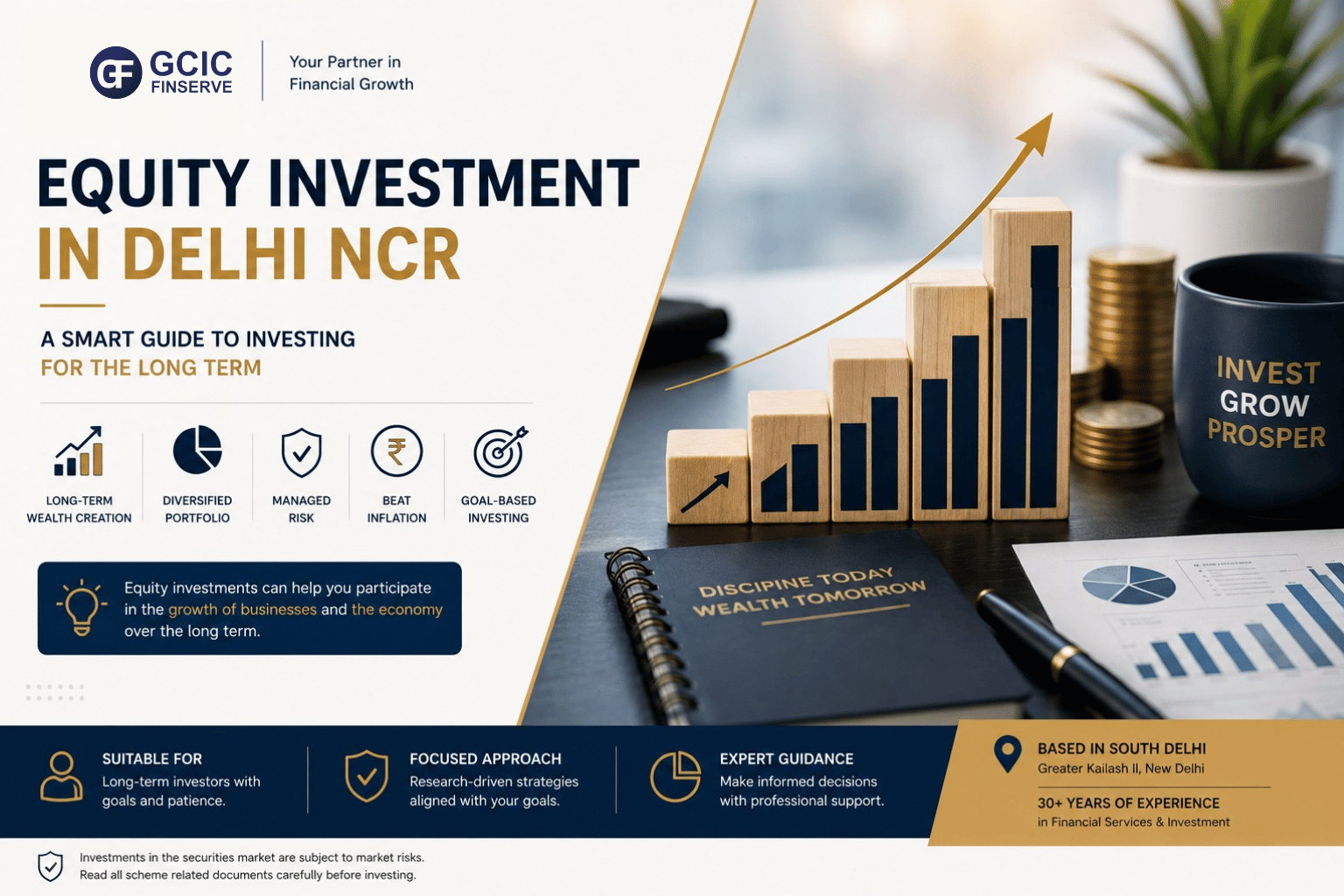
Equity Investment in Delhi NCR: A Smart Guide to Investing for the Long Term

Equity investment Delhi NCR

Equity investment Delhi NCR
Equity investment in Delhi NCR focused on long-term wealth creation, diversification and goal-based investing.

Equity investment Delhi NCR can be an effective way to participate in the long-term growth of businesses and the wider economy. For investors across South Delhi, Noida, Ghaziabad, Gurugram, and other parts of Delhi NCR, equity investments can have a place in a well-planned financial strategy. However, equity investments are market-linked and involve risk, so understanding your goals, risk appetite, and investment horizon is important before investing.

Choosing the right equity investment Delhi NCR approach depends on your financial goals, investment horizon, and tolerance for market fluctuations.

What Is Equity Investment Delhi NCR?

In plain terms, an equity investment means buying a stake in a company—either directly through shares or indirectly through products like equity mutual funds and other market-linked strategies.

When a company does well and its market value climbs, investors can benefit through capital appreciation. Some companies also pay dividends, though that depends entirely on their own policies and the applicable rules.

Of course, the reverse is true too. Equity prices fall as often as they rise, and there’s no such thing as a guaranteed return here. SEBI is fairly direct about this—investors should choose investments based on their own goals and risk appetite, not on tips or rumors picked up along the way.

Why Consider Equity for Long-Term Goals?

Equity tends to suit investors who can stay invested for the long haul and won’t panic every time the market has a rough week.

Instead of reacting to daily ups and downs, a long-term investor can stay focused on the bigger picture—things like

  • Building long-term wealth
  • Planning for retirement
  • Funding future education
  • Creating a diversified portfolio
  • Staying ahead of inflation over time

The point worth remembering: equity investing was never meant to be a quick-money game. It rewards patience and a disciplined approach far more than it rewards timing the market.

How Can You Actually Invest in Equity?

There’s more than one route in. You can buy individual shares directly through the securities market or go the diversified route through equity mutual funds and index funds.

If you’re investing directly in the market, you’ll typically need a bank account, a trading account, and a demat account set up first.

Which path makes sense for you really comes down to your own knowledge, your investment objective, how long you plan to stay invested, and how much risk you’re comfortable carrying.

Why Diversification Matters More Than It Seems

Putting all your money into one company, or even one sector, raises your concentration risk more than most people realize. Diversification spreads that exposure across different companies, sectors, or strategies—so one bad quarter for one company doesn’t sink your entire portfolio.

It’s exactly why many investors lean toward diversified equity funds or index-based approaches instead of trying to hand-pick individual stocks themselves.

Why Consider GCIC Finserve for Equity Investments?

If you’re exploring equity investment options in Delhi NCR, GCIC Finserve gives you access to a range of equity-oriented offerings.

GCIC Finserve offers equity exposure across index funds and active strategies through mutual funds and SMAs, which means investors have more than one way to approach equity depending on their own financial objectives and preferences.

The firm also emphasizes client relationships, with a team that brings 30 years of experience in the financial services and investment domain.

That said, chasing whatever’s performed well recently isn’t a strategy—it’s worth weighing your own goals, risk profile, time horizon, and overall portfolio before deciding where equity fits in.

Start With a Plan, Not a Tip

Equity investing means a lot more when it’s tied to an actual financial goal, rather than chased for its own sake. Markets will move—that’s normal—but impulsive decisions based on rumors, social media chatter, or short-term trends tend to create risks you don’t need to take on. SEBI has been clear about this too, cautioning investors against hot tips and urging them to understand a product and its risks before investing in it.

If you’re looking for equity investment options in Delhi NCR, GCIC Finserve can help you understand the different equity-oriented solutions available and build an approach around what you’re actually trying to achieve.


Disclaimer: Investments in the securities market are subject to market risks. There is no assurance or guarantee of returns. This article is for educational purposes only and should not be considered investment advice. Please consider your investment objectives, risk appetite, and investment horizon and review all applicable product documents before investing.

How to Invest in Mutual Funds During Market Volatility

How to Invest in Mutual Funds

Investing in mutual funds during market volatility can feel challenging, especially when markets experience sharp ups and downs. However, volatility is a normal part of investing and can also create opportunities for disciplined long-term investors. If you are wondering how to approach mutual funds during market volatility, this guide explains practical strategies to manage risk and stay focused on your financial goals.

Understanding Market Volatility and Mutual Funds

Volatility simply means frequent price fluctuations in the market. These movements can be triggered by global events, economic changes, policy decisions, or investor sentiment. For mutual fund investors, this can feel unsettling—but history shows that markets tend to recover over time, rewarding patient investors. That’s why building a long-term mutual fund strategy during market volatility is more important than trying to time the market.

Mutual Fund Investment Strategies in Volatile Markets

Here are some proven mutual fund investment strategies in volatile markets:

  1. Stick to SIPs (Systematic Investment Plans)
    A mutual fund SIP investment in volatile markets allows you to invest fixed amounts regularly. This helps you buy more units when prices are low and fewer when prices are high, averaging out your cost over time.

  2. Diversify Your Portfolio
    Spread your investments across equity, debt, and hybrid funds. This reduces risk, as not all asset classes move in the same direction during market turbulence.

  3. Focus on Quality Funds
    Choose funds with strong track records, experienced fund managers, and consistent performance. Quality funds tend to recover faster after downturns.

  4. Avoid Panic Selling
    Selling during dips locks in losses. Instead, focus on your goals and remember that volatility is temporary.

Best Mutual Funds for Market Volatility

If you are exploring the best mutual funds for market volatility, here are a few categories to consider:

  • Large-Cap Equity Funds – These invest in established companies with relatively stable earnings.

  • Balanced or Hybrid Funds – A mix of equity and debt to balance growth and safety.

  • Dynamic Asset Allocation Funds – Actively adjust allocations between equity and debt based on market conditions.

  • Debt Funds – For investors seeking stability and lower risk during turbulent times.

Safe Mutual Funds During Market Crash

While no investment is entirely risk-free, some categories are considered safe mutual funds during a market crash:

  • Liquid Funds

  • Overnight Funds

  • Short-Term Debt Funds

These provide stability and liquidity while reducing exposure to equity volatility.

Mutual Fund Risk Management in Volatile Markets

Risk management is crucial when investing in mutual funds when markets are unstable. A few tips include:

  • Rebalance your portfolio regularly to maintain your desired asset allocation.

  • Keep an emergency fund so you don’t withdraw investments prematurely.

  • Avoid overexposure to highly volatile sectors or thematic funds.

Should I Invest in Mutual Funds During Market Volatility?

A common question investors ask is: “Should I invest in mutual funds during market volatility?” The answer is yes—if you have a long-term perspective. Market volatility is often short-term noise, but mutual funds are designed to build wealth over years. In fact, entering during market dips often provides the potential for higher returns when markets recover.

Long-Term Mutual Fund Strategy During Market Volatility

The golden rule is: time in the market is more important than timing the market. A long-term mutual fund strategy during market volatility may include:

  • Continuing SIPs consistently.

  • Adding to investments during major corrections (if financially possible).

  • Reviewing your financial goals rather than reacting to short-term market swings.

Final Thoughts

Volatility is a natural part of investing and should not deter you from wealth creation. By following smart mutual fund investment strategies in volatile markets, staying disciplined with SIPs, and choosing the best mutual funds for market volatility, you can turn instability into an advantage. Remember, patience and consistency are your strongest allies.

How to Invest in Mutual Funds

Getting started with mutual fund investing is simpler with GCIC Finserv. Contact us now

Equity, Debt, or Hybrid? How to Choose the Right Mutual Fund for Your Goals

How to Choose the Right Mutual Fund

Mutual Fund Selection is an important step when you want to invest in mutual funds based on your financial goals. With equity, debt and hybrid mutual funds offering different levels of risk and potential returns, choosing the right option can feel overwhelming.

Understanding the Three Main Types of Mutual Funds

1. Equity Mutual Funds

Equity mutual funds invest primarily in shares of companies.

  • Who are they for? Investors with long-term goals, such as wealth creation, retirement planning, or funding a child’s education.

  • Pros: Potential for high returns over time, tax benefits if held for over one year, and a hedge against inflation.

  • Cons: Higher risk due to market volatility, making them less suitable for short-term investments.

2. Debt Mutual Funds

Debt mutual funds invest in bonds, government securities, and other fixed-income instruments.

  • Who are they for? Conservative investors seeking stable income, capital preservation, or short-term parking of funds.

  • Pros: Lower risk than equity, predictable returns, and better liquidity compared to fixed deposits.

  • Cons: Returns are generally lower than equities, and they may still face interest rate or credit risk.

3. Hybrid Mutual Funds

Hybrid mutual funds invest in a mix of equity and debt instruments.

  • Who are they for? Investors who want a balanced approach—some growth potential without taking on full equity risk.

  • Pros: Diversification reduces risk, automatic rebalancing between equity and debt, and suitability for medium-term goals.

  • Cons: Returns are moderate, and performance can vary depending on market conditions.

How to Match Funds with Your Investment Goals

When choosing between these funds, align them with your personal investment goals:

  1. Short-Term Goals (up to 3 years):
    Debt mutual funds are more appropriate as they offer safety and predictable income.
    Examples: Building an emergency fund, saving for a vacation, or meeting upcoming expenses.

  2. Medium-Term Goals (3–5 years):
    Hybrid mutual funds strike a balance between growth and stability.
    Examples: Down payment for a house, funding a wedding, or building a safety corpus.

  3. Long-Term Goals (5+ years):
    Equity mutual funds are ideal for wealth creation, as they have the potential to outperform other assets over time.
    Examples: Retirement planning, children’s education, or building a financial legacy.

Key Factors for Effective Mutual Fund Selection

  1. Risk Appetite: Understand whether you are conservative, moderate, or aggressive.

  2. Time Horizon: Longer durations allow you to absorb short-term market fluctuations.

  3. Financial Goals: Be clear about whether you need growth, income, or a mix of both.

  4. Fund Performance & Costs: Look at the track record, expense ratio, and portfolio composition before investing.

  5. Tax Efficiency: Consider how capital gains tax impacts your overall returns.

Final Thoughts

Choosing between equity mutual funds, debt mutual funds, or hybrid mutual funds isn’t about finding the “best” fund in isolation—it’s about finding the right fit for your investment goals. By aligning your choices with your risk tolerance, time horizon, and financial objectives, you can make smarter decisions and stay on track to build long-term wealth.

Successful investing begins with informed mutual fund selection. Take the time to evaluate your needs carefully, and if necessary, consult a financial advisor to craft a plan that works for you.

How to Invest in Mutual Funds

Getting started with mutual fund investing is simpler with GCIC Finserv. Contact us now